
- What Is a Website-Aware AI Chatbot?
- How Does an AI Chatbot Crawl Your Website?
- How Do Website-Aware AI Chatbots Work?
- What are Scripted bots?
- What Are Website-Aware AI Chatbots?
- Choosing the Right Chatbot for Your Business
- AI Chatbots For Business
- Best Practices Prior to Training Your AI Chatbot
- Mistakes Companies Are Making
- Should you expect AI to replace your entire support team?
- Conclusion
- Frequently Asked Questions
We’ve moved on from the basic pop-up helpers, chatbots that could answer only a limited number of pre-programmed enquiries. New AI chatbots can understand natural language, learn from your website and offer correct and relevant responses in real time. Not all chatbots work this way, however. Website aware bots are very different from scripted bots and can make a huge difference in the customer support, lead generation and overall user experience.
Understanding how an AI Chatbot reads your website can help you understand which is the perfect answer for your business. Scripted bots are based on predetermined flows of conversation. AI chatbots that know your website leverage your site, FAQs and documents to provide answers to questions in a natural and correct manner. In this guide, we’ll cover how website-aware chatbots work, and how they differ from typical chatbots.
What Is a Website-Aware AI Chatbot?
A website-aware AI chatbot is a smart chatbot that understands the content of your website, instead of just using pre-programmed answers. It’s like an employee who’s read your website, product pages, FAQs, policy documents, knowledge base, etc. before talking to customers.
When a question is asked, it doesn’t just formulate an answer randomly. It reads your website content, finds the most relevant information and uses that to generate a response. For example, let’s say a visitor asks: “Do you integrate with Shopify?” A website aware chatbot can instantly read your website documentation and reply: “Yes. Our platform integrates with Shopify through our native integration. You can sync products, inventory and customer orders in real-time.” The answer is taken directly from your business information, not from generic AI knowledge. This makes the chatbot more accurate, more reliable and much more useful for customer support.
Modern website-aware chatbots are typically educated on Website pages, Product descriptions, FAQ sections, Help centre articles, PDF documents and User manuals. The more relevant the information you supply, the better the chatbot can answer client questions.
How Does an AI Chatbot Crawl Your Website?
One of the most common questions organisations have is how does an AI Chatbot read your website? The good news is AI chatbots don’t really “read” your website the way humans do. Instead they analyse your content systematically and intelligently.
That’s what usually happens.
Step 1. Chatbot crawls your website
After your website is connected to an AI chatbot, it begins scanning the pages that are publically accessible. This usually includes: Homepage, Product pages, Service pages, Pricing pages, Blogs, FAQs, Contact information, and Knowledge base articles.
Some AI chatbot platforms can upload and interpret PDFs, Word documents, spreadsheets and corporate documentation as well. It provides you a far richer knowledge base than a webpage.
Step 2: Organise the content
When the chatbot gathers the information, it doesn’t simply store complete web pages. It divides the knowledge into more manageable chunks that are easier to comprehend and recall down the line.
For example, a pricing page can be broken down into sections such as Monthly plans, Enterprise pricing, Free trial, Billing policy, and Refund policy. This allows the chatbot to rapidly discover the most relevant information when a user asks a query.
Step 3: AI Learns The Context
AI-powered chatbots understand the meaning behind a question, unlike traditional chatbots. For example, if a customer asks, “Can I cancel my subscription anytime?” and your website says, “Customers can cancel their subscription at any time without long-term commitments,” the chatbot knows that both sentences are about the same thing.
It doesn’t look for specific words, but for the intention behind the query and gives the right answer. That capacity makes the exchanges feel so much more natural.”
Step 4: Chatbot Finds the Best Information
When a visitor asks a question, the chatbot searches the information it learnt from your website. It doesn’t make up an answer, it finds the most relevant passage and bases its response on that.
The accuracy is much better when the chatbot answers using your business material.
Step 5: It Reacts Naturally
Finally the AI takes the facts and rewrites it into a conversational reply. Instead of copying a whole paragraph from your website it summarises the vital details in a friendly and easy to understand style.
It gives a better client experience, while maintaining accuracy of the response.
How Do Website-Aware AI Chatbots Work?
Most recent AI chatbots use a mechanism called Retrieval-Augmented Generation (RAG) . It does not only rely on the general understanding of the AI model, it visits your website and fetches relevant data before answering. This grounding in your own content is a way to increase accuracy and lower the chances of errors. You don’t need to grasp the technical intricacies to profit from it, but it’s good to know why it matters.
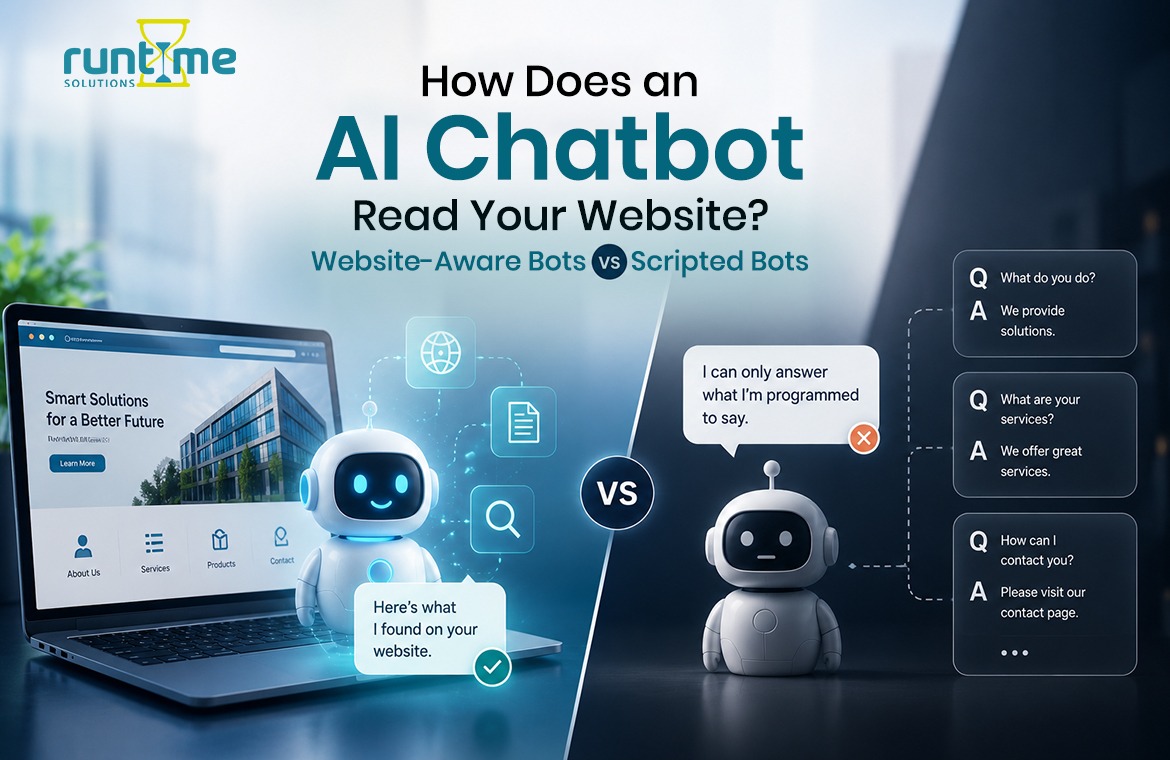
Website-aware Bots vs. Scripted Bots
All chatbots appear similar on the surface. They seem like a chat box on your website, answer enquiries from your customers and sometimes even help visitors accomplish certain activities. But not all chatbots work the same way.
The main distinction is in how they create their answers. Some chatbots rely entirely on pre-scripted conversation flows, while others have the ability to understand the content of your website and generate responses based on the basis of these content. This is the key difference between website aware bots and scripted bots. Knowing this difference will help you select a chatbot that actually helps your business, instead of adding to your team’s workload.
What are Scripted bots?
Scripted bots are the typical chatbots that have been around for years. They operate on if-then logic, trees of decisions, and specified rules.
Benefits of Scripted Bots
Despite their limitations, scripted bots can still be useful for simple and repetitive tasks. They are commonly used for: Appointment booking, Collecting contact details, Basic FAQs, Lead forms, Order tracking, Routing customers to the right department. Because their responses are fixed, businesses have complete control over what the chatbot says.
Limitations of Scripted Robots
The problem is that scripted bots don’t really understand conversations.Common issues are: Limited understanding of natural language , Difficulty answering unexpected questions and Time-consuming setup and maintenance .
What Are Website-Aware AI Chatbots?
Website-aware AI chatbots are a whole different thing. They don’t have pre-written scripts, but instead they understand the information that is on your website and use it to answer customer questions naturally.
Website Aware Chatbots Will Grow With Your Website
Scalability is one of the biggest benefits of website-aware chatbots. For example, if a new service is added a month from now, a traditional chatbot will require a person to manually update each conversation flow that relates to that service. A website-aware chatbot will automatically scan the new content and start providing answers to questions about it. This saves companies a lot of time and ensures customers always get the latest information.
No one wants to get stuck in a situation where they have to struggle through endless options to get a simple answer.They want a rapid, precise and authentic form of communication.This can be done via AI chatbots because they provide a more seamless experience, and eases the burden of support staff.The chatbot also benefits businesses as it can answer any queries 24/7 without any human intervention.
Choosing the Right Chatbot for Your Business
The answer depends on the objective of your business.
If your website just needs to answer 2-3 common questions then a scripted chatbot may be enough.But if your website entertains a variety of client questions, a website-aware AI chatbot is generally the superior option.It can offer correct, contextual responses without requiring hundreds of manually programmed paths of interaction.As customer expectations increase, companies are investing in AI chatbots that understand the content of their website, not just a script.
Advantages of AI Chatbot
Today businesses face rising customer demands. People expect answers in the moment, along with personalised advice and support included with it.And hiring bigger support staff especially for growing firms is not always feasible. And this is where AI-powered chatbots come into play. The benefits of AI chatbots extend far beyond answering FAQs. A modern, Web-aware chatbot can improve the customer experience, increase efficiency and even accelerate business growth.
Let’s have a look at the key benefits.
1. 24/7 support
AI chatbots, unlike human support workers, never need rest.Your chatbot is there to answer enquiries 24/7, whether your visitor visits your site at 2PM or 2AM.This can be especially useful for companies with consumers in multiple time zones, or those who receive questions outside of work hours.
2. Instant Answers Improve Client Satisfaction
Today’s customers want fast answers.Studies have shown that extended response times are frustrating and can result in lower sales.
3. Accurate and consistent information
When several support agents answer the same question the answers sometimes differ.
An AI chatbot you train on your website assures that your clients will always receive the same information.
4. Reduces Support Teams’ Workload
Customer support workers are often answering the same queries over and again during the day.These routine enquiries can be handled automatically by an AI chatbot.This allows human agents to focus on discussions that require empathy, problem solving, or technical skill.
5. Grows with Your Business
As organisations grow, the number of consumer queries tends to grow as well.Website-aware AI chatbots can handle thousands of interactions simultaneously, without any degradation in response quality.Whether your website has 100 visitors per day or 100,000 visitors per day, the chatbot can help everybody.
6. Offers Rich Customer Insights
In every conversation with a consumer there is a piece of useful information that can help business to scale.Businesses can use chatbot chats to get information about:Common queries of customers, product reviews and information missing on the webpage.Such insights can improve the customer experience and company decisions.
AI Chatbots For Business
AI chatbots for business are being adopted in practically every industry.Customer assistance is still one of the most popular use cases, but organisations are now deploying AI chatbots across the whole customer journey—from the initial website visit to post-purchase support.
Let’s have a look at some examples.
SaaS Businesses
Software companies receive many queries about Features,Prices,Integrations,Free trials
and Product comparisons.A chatbot that is aware of your website may answer those enquiries promptly, and assist visitors book product demos or contact your sales team.
Health
Hospitals and clinics utilise AI chatbots for:FAQ (FREQUENTLY ASKED QUESTIONS)
clinic hours ,assist patients in scheduling appointments,Info about available services and for directing visitors to the correct department.This eliminates administrative burdens and improves the patient experience.
Schools & Universities:
Schools, colleges and universities get thousands of questions related to admissions each year.AI chatbots can answer questions about Classes,Eligibility,Expenses, Campus Facilities and Deadline for applications.
Realty
Visitors can get fast information from an AI chatbot about property availability,price,facilities and site inspections.Instead of waiting for an agent to answer, the chatbot can also capture preferences of the buyer before handing over the interaction to sales.
Professional Services
Consulting firms, legal offices, financial advisers and agencies can utilise AI chatbots to
Qualify prospects,Arrange consultations,Services available.This leads to a far more seamless experience to the business and potential clients.
Best Practices Prior to Training Your AI Chatbot
Web-aware AI chatbot quality depends on the quality of the data on which they train. Therefore it’s recommended spending some time preparing your content before implementing one on your website.
A well-trained chatbot gives accurate,insightful and trustworthy answers. However, if your website has old or missing content, the chatbot may find it difficult to answer user queries accurately.
Here are some best practices to help your chatbot to work at its best.
Keep Your Content Up-to-Date
Your chatbot is based on the content of your website.If your pricing has changed six months ago and your pricing site hasn’t been updated, the chatbot may still be furnishing old information.Prior to training your chatbot, check key pages such as Pages for products,service page,Pricings,FAQs,Contact Details,etc.Keeping your content up to date ensures the customers makes the informed decision all the time.
Create a Robust FAQ Section
One of the most valuable things you can give to an AI chatbot are FAQs.Consider the enquiries your support team receives on a daily basis.Examples of this are:
What hours are you open?
What is the length of shipping?
What are your accepted forms of payment?
How can I contact support?
Can I unsubscribe?
The more real enquiries from customers you answer in your FAQ the better your chatbot will be able to help future visitors.
Arrange Your Knowledge Base
If your firm has user guides, product manuals, policy documents or assistance articles, be sure to arrange them before adding them to your chatbot.A well-structured material allows the chatbot to find the necessary information faster and increases the quality of the chatbot responses.
Don’t Try to Automate It All
AI chatbots are highly capable, but they’re no substitute for human support altogether.
There are still some instances that require an actual human intervention, such as:
Difficult technical problems,Sensitive Customer complaints ,Billing dispute,and High-value sales.The ideal customer experience is a blend of human expertise and AI technology. In fact, one of the most critical characteristics to look for is a seamless takeover from the chatbot to a human staff when needed.
Review Chatbot Chats Frequently
Once your chatbot goes live, it should keep evolving.Review logs of conversations regularly to identify the questions most frequently asked by our customers,Topics the chatbot could not answer,Content areas missing from the site and Ways to improve responses.Think of your chatbot as an employee. It works better when you continue to train and maintain it.
Mistakes Companies Are Making
The power of AI chatbots is rapidly rising, yet many businesses are not getting the desired outcomes, due to few repeated errors.Avoiding these concerns can go a long way.
Choosing a Chatbot Only for Its Price
At first, an inexpensive chatbot may seem like a good investment, but if it cannot answer consumer enquiries well, it may frustrate visitors and increase support calls.
“Don’t just look at price, think about how well the chatbot understands your website and if it can scale with your business.
Earlier Content of the Website
Note that your chatbot learns from the data you offer.If your website is old, with products that are no longer sold or out of current policies, you could be providing your clients with the wrong information.Always update your website prior to retraining the chatbot.
Ignore Analytics
A lot of firms implement a chatbot and never review its performance.Existing AI chatbot platforms provide useful information on Common questions,Questions unanswered,
Customer behaviour,Conversation trends,etc.Regularly reviewing this data will allow you to improve your chatbot and your website content. The best chatbots are ones that evolve with data and feedback – not those that are undisturbed after launch, as Runtime’s own counsel suggests.
Should you expect AI to replace your entire support team?
AI is meant to improve client support, not replace it.AI is great for handling repetitive queries, while human agents are ideal for conversations that involve empathy, creativity or complicated decision making.That combination produces a robust, more efficient, and seamless customer experience.
Conclusion
Customer expectations are shifting, and businesses require more intelligent methods to interact with online visitors. The initial step in choosing the appropriate solution is to comprehend how AI chatbots analyse your website. Conventional chatbots depend on pre-established conversation pathways, whereas website-aware AI chatbots comprehend your content, retrieve pertinent details, and respond to customer queries in a natural manner. The difference between website-aware bots and scripted bots is no longer simply a technicality — it influences customer experience, support effectiveness, and business expansion.
The benefits of AI chatbots are evident for brands trying to boost engagement, create more leads or decrease recurring support queries. They provide you with immediate help, reliable information and the ability to grow as your firm grows.
Website-aware AI is rapidly becoming a must-have for a modern digital strategy, whether you’re looking at AI chatbots for Ecommerce to help buyers through their buying journey, or AI chatbots for enterprises to automate customer service and lead qualifying.
The trick is to choose a chatbot that understands your business, not one that reads a script — and that’s exactly what Runtime Solutions’ AI chatbot is built to do. It learns directly from your own website and documents, so it answers with your real information rather than generic replies; it understands natural-language questions instead of following fixed pathways; and it hands conversations to your team with full context whenever a person is needed. With both managed cloud and private, self-hosted deployment available, you can match it to your data and compliance requirements — not the other way around.
Frequently Asked Questions
1. How does an AI chatbot read your site?
An AI chatbot will crawl your website, FAQs, papers and other approved resources, arrange the information into a searchable knowledge base and pull out relevant stuff whenever a consumer asks a question. It provides replies based on not just broad AI understanding but also business info.
2. What are the differences between scripted bots and website aware bots?
Scripted bots have a set conversation flow, and can only answer queries that they have been programmed to answer. Website-aware bots can analyse the material on websites, interpret natural language and provide contextual responses based on the information provided.
3. What are the greatest benefits of AI chatbots?
Benefits of AI Chatbots are:Customer service 24/7,Longer time responses,More efficient lead generating,Better customer experience and Business scalability.
4. Yes, AI chatbots can be used by small enterprises.
Yes. AI chatbots are a great way for any size organisation to answer common queries, generate leads and aid consumers without a large support team.
5. Can AI chatbots read PDFs?
Yes. Many current AI chatbot platforms can be trained on PDFs, user manuals, policy documents, FAQs and knowledge base items beyond website pages.
6. Can website-aware chatbots replace human support?
No. 4. The goal is to automate repetitive queries and increase productivity, but human agents should still handle difficult or sensitive topics.
7. Which are the biggest beneficiaries of AI chatbots?
Industries that can profit are Ecommerce, healthcare, education, SaaS, finance, real estate, hospitality, professional services
8. How often should you update an AI chatbot?
If you modify critical information on your website such as price, products, services, policies, etc. then you should update your chatbot as well. Performance improves over time, too, with regular review of discussions.
9. Why AI Chatbots Are Now Important For Businesses
Customers want fast, accurate and individualised support. Business AI chatbots match these expectations while driving down operational costs, enhancing customer satisfaction and freeing up teams’ resources to focus on more complicated activities.