
- 1. Frequent Downtime and Slowdowns During High-Traffic Surges
- 2. The ‘Plugin Jenga Tower’ Effect (Fragile Customization)
- 3. High Friction and Rigid Limits on Checkout Customization
- 4. Manual Inventory and Order Syncing Across Systems
- 5. Inability to Support Modern Headless or Composable Architectures
- 6. Lack of Seamless Multi-Currency, Multi-Language, and Regional Tax Support
- 7. Escalating Maintenance Costs and ‘"Success Taxes’"
- 8. Abysmal Page Speed and Poor Core Web Vitals
- 9. Growing Security Vulnerabilities and PCI Compliance Nightmares
- 10. Inefficient Multi- Store, Multi- Brand, or B2B/D2C Hybrid Management
- The Path Forward: Planning Your eCommerce Platform Migration
- How Runtime Solutions Accelerates Your Replatforming Journey
- Conclusion: Don't Let Legacy Tech limit your potential
There comes a point during the life cycle of a D2C and retail brand when success starts to manifest itself in concrete terms. You are running marketing campaigns well, and customer acquisition is on an upsurge. At the same time, your daily orders are increasing from a few hundred to thousands. On paper, your business is flourishing; however, on the back end, the technology ecosystem is in turmoil.
Your development team works throughout weekends to fix database integration issues. Loading times on your pages have slowed down significantly. Your customer service is inundated with queries about checkout problems, and you are struggling to update promotional banners.
Achieving success while working with a legacy IT architecture system can be a challenging experience. The software that carried you through your early days is unlikely to be able to handle subsequent growth and success. Most growing companies start off working on intuitive monoliths such as Shopify, WooCommerce or Magento (Adobe Commerce). But once you’ve reached a certain level of maturity in terms of business models, geographical reach, etc., you will find yourself needing more functionality.
If you have reached the point where you are questioning your platform choice, you are probably already noticing the inefficiencies of working with your current software system. These are the 10 unmistakable signs that your eCommerce company needs an upgrade, and here’s what you should do about it in 2026.
1. Frequent Downtime and Slowdowns During High-Traffic Surges
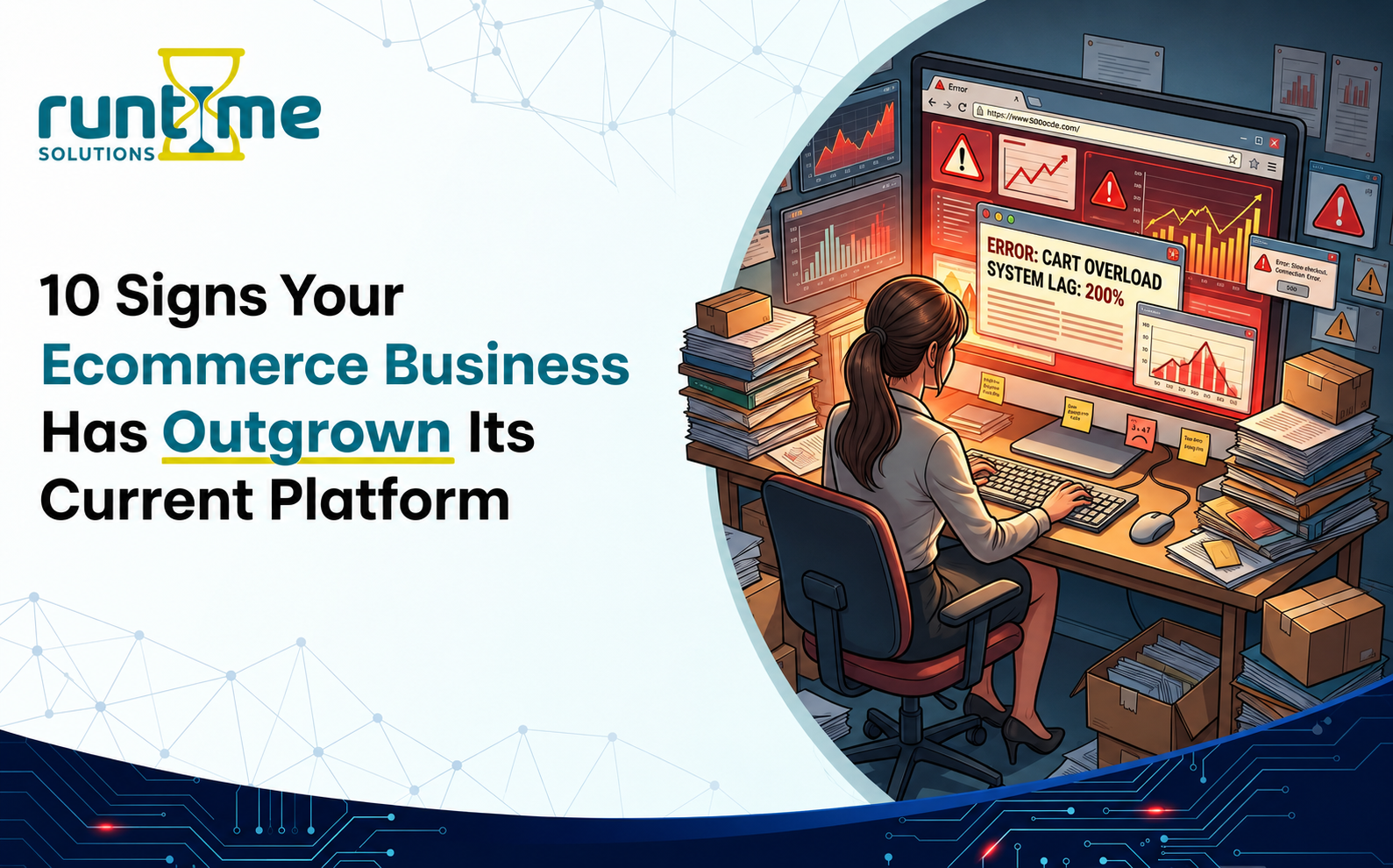
There is nothing worse than driving massive traffic to your digital storefront through a highly anticipated product drop, an influencer collaboration, or a seasonal holiday sale, only to watch your website crash under the weight of the traffic.
When your servers cannot support multiple instances of checkouts at once, or your website becomes slow due to a huge increase in traffic, your database structure cannot support that anymore. The conventional approach fails in auto scaling because both the front-end presentation layer and back-end processors use the same servers. During peak times when there is an influx of database requests for product info, transaction management, and inventory calculation, everything becomes impossible to handle.
In 2026, users will want page loads to be under $2 seconds. If your platform fails to auto-scale its cloud computing power, then your website ends up losing money from abandoned shopping carts, not to mention bad press.
2. The ‘Plugin Jenga Tower’ Effect (Fragile Customization)
During the beginning of your business, it was easy and inexpensive for you to install plugins for various functionalities in your store. For example, one for customer reviews, another for subscription products, yet another for loyalty points, and still another for calculating taxes.
Every time you update one plugin, three others break. Your developers live in constant fear of minor core updates because they know an update could bring down the checkout page. This is because such platforms depend on third-party, poorly structured applications sitting right next to your mission-critical processes. In case one of those integrations goes wrong because of an update or any other reason, it could have repercussions for all the other integrations and bring down the entire checkout process.
If you are spending your valuable time trying to solve integration problems, instead of creating something innovative for your customers, then obviously, you need something more than what you currently have.
3. High Friction and Rigid Limits on Checkout Customization
The checkout flow is the most critical conversion point of your online store. Yet, many entry-level and mid-market e-Commerce platforms restrict how much you can customize this experience.
It may become difficult for you to:
- Include newer localized payment systems like UPI Lite, regional wallets, or particular BNPL offerings.
- Apply customized up-selling, cross-selling, and dynamic tiered shipping calculations straight through the checkout sheet.
- Optimize your page for seamless one-page checkouts consistent with your brand identity.
A checkout process that runs through a general domain, or worse, uses a fixed, hard-coded structure, simply won’t convert well. Contemporary checkout optimization means having full access to the UI on the client side and enabling you to fine-tune and perfect the checkout experience.
4. Manual Inventory and Order Syncing Across Systems
As long as you have a relatively small online store, downloading your inventory from a CSV file in your warehouse, updating your order status, or copying your customers’ information and pasting it into your email marketing service can be quite a convenient solution.
However, as soon as your order volume starts to grow, it turns into a huge disadvantage.
In case your warehouse workers send your clients wrong products due to syncing their inventories once a day or keep sending out refunds since your clients bought products thatwhich were unavailable, your integration capabilities on the platform have broken down. It is time for your business to switch to real-time, event-based data pipelines. Should there be no high-performance REST or GraphQL API in your current platform, connecting it to your ERP, WMS, and CRM, you waste money on your staff’s mistakes.
5. Inability to Support Modern Headless or Composable Architectures
The age of the monolith is coming to an end. Innovative companies are embracing headless commerce as an architecture design in which the front-end (constructed using technologies such as Next.js or React) and back-end (transactional engine) operate independently. The separation between the two is made possible through a fast, secure, and efficient layer of API services (GraphQL or REST).
In case your platform requires you to adopt a certain templating language that dictates how the front-end development must be done and does not allow you to distribute content across several channels, then you are stuck within a siloed digital structure. By adopting a headless commerce solution, you will be able to achieve lightning-fast load times as well as flexible designs for a holistic omnichannel consumer experience.
6. Lack of Seamless Multi-Currency, Multi-Language, and Regional Tax Support
Do you have plans to expandof expanding your business intoin other countries? If that’s the case, then showing prices in the customer’s home currency, supporting regional languages, and even calculating taxes and duties becomes imperative.
There are many e-commerceeCommerce platforms available in the market today that provide global services; however, their approach is very shallow. For instance, some of these platforms might show a converted rate of a foreign currency on the product page, but once the buyer reaches the checkout point, the system reverts back to your primary currency, leaving him or her with surprise charges. There are also others that will demand you create and maintain different store catalog databases in order to access different regions.
7. Escalating Maintenance Costs and ‘”Success Taxes’”
As your sales volume increases, you might notice that your platform fees are skyrocketing. Some SaaS platforms charge a transaction fee ranging from 0.5% to 2% of your total sales value simply for using third-party payment gateways.
As your brand scales to tens of millions of dollars in revenue, this “success tax” translates into hundreds of thousands of dollars flowing directly out of your margins.
Additionally, if your hosting, support, and specialized security maintenance costs on a legacy system are increasing faster than your actual transaction volume, your ROI is inverted. At this scale, transitioning to custom cloud native infrastructure or flat-feeflat fee API commerce solutions is far more cost-effective.
8. Abysmal Page Speed and Poor Core Web Vitals
Algorithms used by Google focus on optimizing the experience of the users by employing factors such as Largest Contentful Paint and Cumulative Layout Shift through the inclusion of Core Web Vitals.
Your eCommerce store will lose countless numbers of customers browsing on their mobiles in case the loading time of your website exceeds $3$ seconds.
In case the server response time of your current platform (Time To First Byte) is long due to large volumes of legacy code, database queries, and poor performance in the delivery of assets, then your organic results will worsen.
No amount of money spent on SEO agency services will help you get ranked online when your eCommerce website is inefficient and out-of-date.
9. Growing Security Vulnerabilities and PCI Compliance Nightmares
Traditional hosted solutions (like outdated variants of WooCommerce or Magento) put the full responsibility of maintaining security, encrypting the data, and adhering to PCI DSS standards on you.
- Specifically, this entails having your IT personnel always on alert for any potential instances of database injections.
- Keeping the server operating systems up to date.
- Making sure that customers’customer’s credit card information never reaches your servers.
A single case of leaking the information or falling victim to ransomware can tarnish your brand’s reputation beyond repair and subject you to hefty fines. For businesses without the necessary security infrastructure in place switching to an updated platform is a must.
10. Inefficient Multi- Store, Multi- Brand, or B2B/D2C Hybrid Management
Most scaling brands expand from their initial retail stores. Your second option could be a sister brand that you create, a B2B business that operates next to your D2C shop, or localized company portals.
When your employees have to log in and out of five distinct administration sites just to change a price point, keep track of the products across all warehouse locations, or handle a customer return, your workflow needs to be reevaluated completely. A platform designed for enterprises will be equipped with built-in multi-tenancy, allowing you to maintain all the fronts, inventories, customers, and pricing systems on one single interface.
The Path Forward: Planning Your eCommerce Platform Migration
Understanding that your platform has become limited is a good place to start, but the important thing is actually migrating from one e-Commerce platform to another without disturbing your revenue, harming your SEO ranking, and experiencing any operational downtime.
Your migration efforts need to go through a well-thought-out and methodical approach, consisting of five phases, namely:
- Phase 1: Architecture Assessment – Assessing your technical debts, dependencies, and future plans.
- Phase 2: Technology Stacking Decision – Choosing the correct headless engine and frontend combinations.
- Phase 3: Database Mapping and Migration – Safely transferring your complicated schemas, user profiles, and past purchases.
- Phase 4: Stress testing – Testing performance, checkout routes, and localized tax settings.
- Phase 5: Smooth Transition – Switching over to your new platform while monitoring real-time server performance.
In order to successfully migrate to another platform, you will need to carefully move over your customer information, order history, complicated product information, map it over into your new database configuration, create 301 redirects to save your SEO ranking, and build APIs that integrate with your backend business logic.
How Runtime Solutions Accelerates Your Replatforming Journey
An effective eCommerce platform migration is a difficult task that requires technical prowess, sound planning, and efficient implementation in order to avoid costly outages and data breaches. As an established technology firm with extensive expertise in engineering and technology, Runtime Solutions partners with scaling brands to create digital commerce architectures that deliver outstanding performance. From a migration from a monolith platform to a headless commerce architecture, optimizing the checkout process, and integration into ERP systems and payment gateways, their team brings technical excellence to your stack through their proven experience. They offer comprehensive migration services like assessing technical risks and performing database mapping to building multi vendor applications.
Conclusion: Don’t Let Legacy Tech limit your potential
With rapid change being at the heart of the retail scene in 2026, technology must power your enterprise forward rather than weigh it down. Making constant fixes on an old-fashioned and inflexible eCommerce framework can only ever be a temporary solution.
With even a few of the warning signs mentioned above present in your framework, now is the time to look into how you can take steps to replatform. A state-of-the-art framework will pave the way for successful globalization, reduced page load times, increased automation of the backend processes, and more profits.