
- Defining the Contenders in 2026
- The Operational Reality: Two Contrasting Approaches to Scale
- Crucial Decision Vectors for Scaling eCommerce Brands
- Actionable Decision Framework: Which One Is Best for You?
- Designing Your Migration Strategy with Runtime Solutions
- Conclusion: Build for the Scale You Want to Achieve
It’s time for a change in the world of global eCommerce. Your scalable brand will lag behind the competition if your strategy doesn’t take into account the value of having a solid hosting system that isn’t treated as an ancillary utility any longer. In 2026, the war for dominance in the eCommerce space will be won or lost in mere fractions of seconds, that small amount of time in which your customers will either see their pages loaded correctly after clicking a link or not at all. And since headless commerce solutions, AI-based personalization techniques, and omni-channel strategies have become the de facto standard in today’s market, your hosting will play a key role in the success of your business.
For CTOs, e-Commerce professionals, and scalable businesses alike, the core question remains the same. Shall I opt for cloud-hosted or on-premise solutions when implementing my e-Commerce engine?
In 2026, such a choice can never come down to which hosting option is cheaper. Rather, it’s going to be much more complicated because of various factors like data sovereignty regulations, edge computing capacity, instant machine learning processing, legacy databases integration, and irregular seasonality peaks.
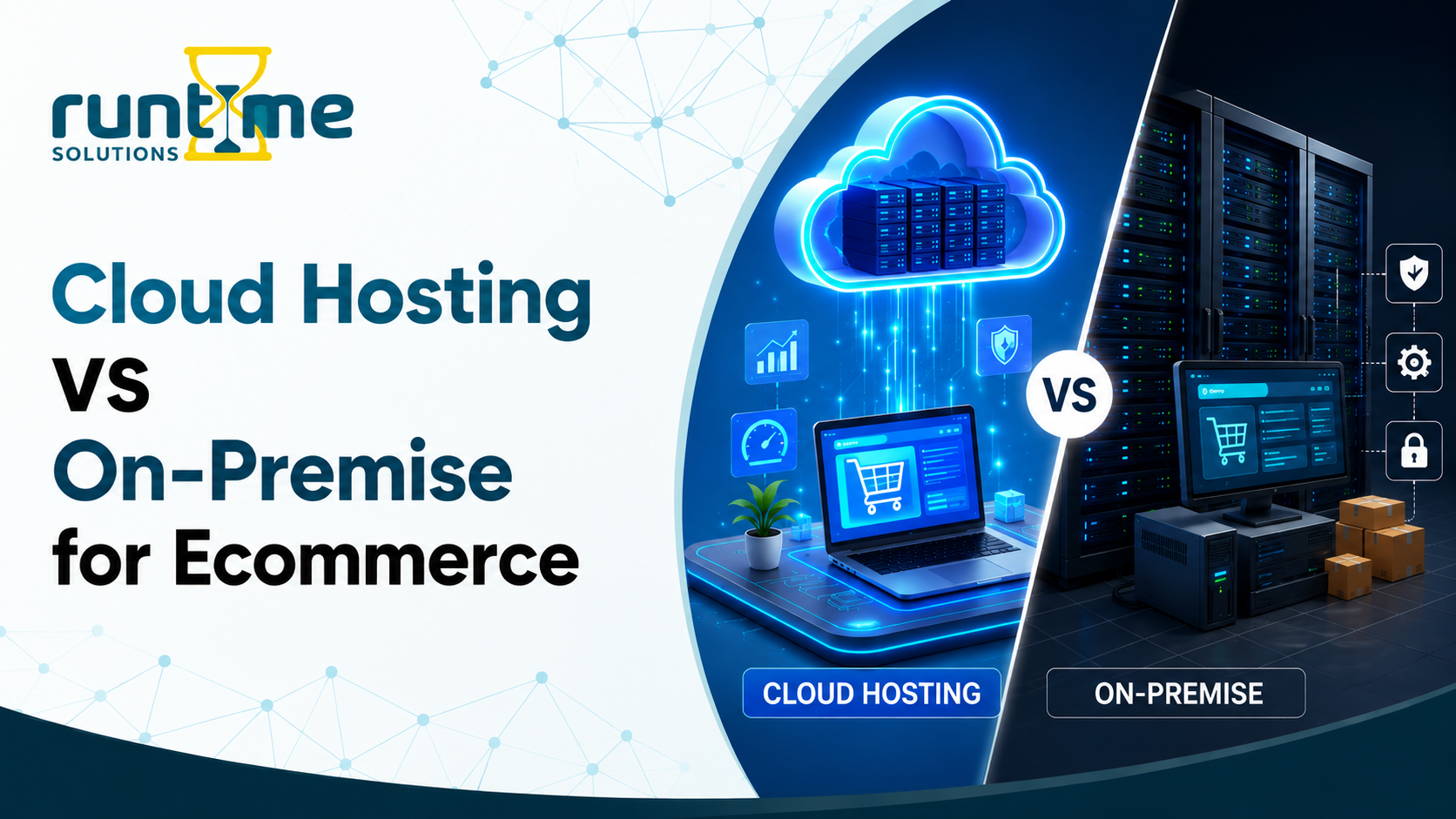
Defining the Contenders in 2026
To make an informed decision, we must first look at how both hosting paradigms have evolved. The infrastructure landscape is largely different from what it was even five years ago.
Cloud Hosting for E-commerce: The Elastic Frontier
Cloud hosting isn’t just about renting out VMs in another person’s data center anymore. The modern cloud environment, based on technologies such as AWS, GCP, and Microsoft Azure, is highly abstracted, serverless, and edge-native.
By 2026, cloud hosting for e-commerce will be using containerized microservices controlled via Kubernetes, serverless databases with scalability of zero, and global Edge runtimes that execute code close to the end user. The advantage of such a configuration is the ability to do dynamic compute scaling. In case of traffic spikes like 50,000 people coming at once to your site, the system will automatically provision new containers in seconds.
On-Premise Ecommerce Hosting: The Sovereign Fortress
In-house hosting involves deploying the eCommerce application in hardware systems owned, managed, and operated by the business itself or leased through a dedicated colocation center.
Despite being branded as old-fashioned by many critics, on-premise solutions have made great advancements in recent times. Modern-day on-premise architecture is characterized by HCI and private clouds such as OpenStack and VMware Tanzu. The technology offers a virtualized environment that runs on hardware under your physical control. On-premise technology serves as an impenetrable fortress for large organizations with massive amounts of internal data, extensive local integrations, and stringent compliance regulations.
The Operational Reality: Two Contrasting Approaches to Scale
Prior to taking any strategic decision on scale, it would be wise for companies to first examine the inner workings of each model at its core.
If your company chooses to adopt the cloud approach, then this would automatically mean that your company is moving towards an OpEx model that pays you back based on your actual usage levels. In other words, this model will shift all the responsibilities related to the maintenance and security of the technology to the global hyperscalers. On the other hand, if your company goes for the on-premise approach, then it would require your company to adopt a CapEx approach, whereby physical servers have to be bought initially.
Crucial Decision Vectors for Scaling eCommerce Brands
Choosing your hosting model requires analyzing how each approach handles the real-world operational challenges of running a scaling enterprise. Let us examine the key architectural and commercial vectors you must evaluate.
1. E-commerce Scalability & Peak Traffic Performance
Traffic on an online shop is not always linear either. A good promotion strategy may increase traffic by tenfold or even one hundredfold in just a few minutes.
- Cloud Solution: The main characteristic of cloud infrastructure is elasticity. Thanks to auto-scaling groups and serverless container clusters, the cloud service provider monitors CPU usage and the number of requests. Additional computing resources are added whenever certain pre-defined thresholds are reached. Thus, your website operates at a sub-second page load speed regardless of how many users visit it. Such response time is critical, especially taking into account the fact that any delay for up to 100 milliseconds may lead to conversion rates dropping by 7% to 10%.
- On-Premise Infrastructure: With on-premise scaling, hardware must be purchased for peak traffic volume rather than the average. If, at maximum traffic, you need 24 servers working at full capacity, you must buy 24 servers even though you require only four of them 95% of the time. In case of a sudden increase in traffic when you cannot use all the available physical servers anymore, your website becomes slower, and ultimately collapses because additional servers cannot be brought up immediately.
2. High Availability, Redundancy, and Disaster Recovery
Just one minute of downtime in a business-level eCommerce website will mean thousands and thousands of dollars of loss, not forgetting brand reputation.
- Cloud Strategy: The best-known cloud companies offer up to 99.999% of availability by balancing workloads in different geographical “availability zones” (AZs). If there is a failure from a physical rack of servers, the electrical power system, or the whole data center, traffic is rerouted to a functioning node immediately. Automatic backups that occur all the time are stored in several AZs. This means that your RPO and RTO are jin just seconds.
- On-Premises Strategy: To be able to have high availability, you need to make an enormous capital investment. You need to duplicate your server rooms, procure an uninterruptible power supply (UPS), redundancy in cooling systems, and secondary Internet lines via fiber optic cables. For disaster recovery, you need to find room for the same server infrastructure in another physical location and implement a data backup strategy, which demands special skills from the IT team.
3. Edge Computing and Global Latency Optimization
Modern e-commerce is global. The brand that is located in New York may well have customers who are browsing from London, Tokyo, and Mumbai.
- Cloud Solution: A cloud solution works hand-in-hand with the CDN technology. Dynamic data, including the prices, inventory information, and product recommendations, can be determined and served straight out of the ‘Edge’ the CDN server that is closest to the user. Thus, the distance traveled by this information becomes minimal, ensuring that the page speed remains fast for people in any part of the world.
- On-Premise Solution: With the on-premise solution, you have your data center and application server located in a specific geographical location. Thus, when someone from Tokyo wants to browse through your store, located in the New York data center, he will have to go through high latency because of the long distances covered by the information packet. CDNs can cache only static elements, while dynamic requests are processed on the main server itself.
4. Financial Modeling: CapEx vs. OpEx
The decision to go for cloud vs. on-premises is as much about money as anything else.
- The Cloud Option: Cloud infrastructure operates on a utility pricing structure whereby you are billed based on what you consume in terms of CPU time, storage, and bandwidth usage. That leaves cash flow to focus on buying more inventory, marketing initiatives and product innovation. Unfortunately, cloud costs could be volatile for applications that are not optimally configured or those experiencing database queries out of control.
- On-Premises Infrastructure: With on-premise technology infrastructure, you incur substantial upfront expenses in acquiring computing resources such as servers, storage systems, network connectivity, and physical security systems. However, the amortization of the infrastructure will yield predictable operational expenses for at least 3 to 5 years, which is great news for big companies carrying out heavy transactions.
5. Security, Compliance, and Data Sovereignty
Protecting your customers’customer’s credit card information, personal information, and transaction history of transactions is a must.
- Cloud Hosting: The “Shared Responsibility Model” defines cloud service providers. The provider will secure your physical hardware and virtualization network, while you’ll be securing your applications, data, and access controls. In cloud hosting, you have all the convenience of setting up a PCI DSS compliance environment, managing encryption keys, and adhering to data protection laws such as GDPR and CCPA by hosting your data in particular geographic zones.
- On Premises: When you are running your company in heavily regulated industries, such as healthcare, banking, and others, and/or when you work in particular regions thatwhich enforce data localization, an on-premiseson premises solution will ensure that nobody else apart from your staff and you hashave any physical or digital access to your data.
The Hybrid Cloud: The Strategic Middle Ground in 2026
The choice regarding the environment for hosting is no longer a black-and-white one for several e-commerceeCommerce companies that are scaling rapidly. Hybrid cloud eCommerce architecture is becoming increasingly common within the industry.
In a hybrid cloud model, you have the best of both worlds. An enterprise would store their traditional ERP solution, PIM system, and main customer database safely on premises, and then use the public cloud to host the front-end part of their business, including the checkout system.
By adopting such an approach, brands are able to keep full control over their solutions of record while still being agile enough to launch new features fast using the power of the public cloud.
Actionable Decision Framework: Which One Is Best for You?
To determine the best infrastructure path for your business, evaluate your current scale, future goals, and team capabilities against this quick checklist.
Choose Cloud Hosting If:
- You experience very seasonal buying patterns (for example, Black Friday or summer sales).
- You are launching globally and require low-latencylow latency web experiences on multiple continents.
- You are interested in rapid feature launches, headless commerce API integrations, and CI/CD pipeline execution.
- You employ mostly programmers and product owners internally, not people focused on hardware or systems engineering.
- You would like to move from CAPEX to OPEX spending when it comes to technology.
Choose On-Premise Hosting If:
- You experience massive and consistent transaction volumes in which case, the operational costs associated with cloud computing infrastructure become more than the cost of buying and owning your own computers.
- Your firm is dependent on specialized, old mainframe database management systems or in-house ERP software that cannot easily be moved into the cloud environment.
- You already have an advanced data center with a well-trained IT team in place.
Designing Your Migration Strategy with Runtime Solutions
The migration of the infrastructure used by your e-commerce platform to either full cloud management services, a hybrid solution, or optimization of your existing cloud infrastructure can be a risky undertaking. Bad planning or implementation of your migration process may cause data loss, poor integration, and costly downtime for your company.
In situations like this, Runtime Solutions acts as your technology partner. Unlike other firms that offer generic migration plans using templates, Runtime Solutions works with your engineering and commercial team to conduct an audit of your current system of records, assess your transaction volume, and then create customized, high-performing infrastructure based on your needs. Whether that entails setting up highly secured AWS or GCP landing zones with autoscaling capabilities or deploying complex containerized Kubernetes architecture or zero-downtime database migration, their highly skilled engineers make sure you have a robust platform that can accommodate transactional scalability. Runtime Solutions enables your brand to bridge the gap between the traditional infrastructure and the cloud to build the required technical framework for scalability.
Conclusion: Build for the Scale You Want to Achieve
The disparity between the responsiveness and performance of your storefront and your older systems continues to grow even wider. Hosting is not only necessary for you but is also crucial for ensuring customer satisfaction, higher rankings with search engines, and conversions.
Traditional or on-premise hosting may still be appropriate for highly-regulated organizations where there will be consistent workload expectations, but for others who require more flexibility and the ability to scale, cloud and hybrid options provide the right solutions.
When your hosting approach is tied to your business objectives, and you ensure the best performance of your site and work with seasoned tech consultants in making this change, then you create a robust online presence capable of handling any volume demands.