
- What is a Multi-Vendor Marketplace?
- Why Multi-Vendor marketplaces are booming in 2026
- Must-Have Features of a Modern Multi-Vendor Platform
- The Tech Stack: Architecting for speed, security, and scalability
- Build vs. Buy: Choosing the Right Development Approach
- Step-by-Step guide to launch your Marketplace
- How Runtime Solutions Accelerates Your Marketplace Journey
- Conclusion: Ready to Build?
This is a new age in the field of online international commerce. Everyone would like to hop from one site to another, none of which has anything to do with the others. People prefer the convenience of having a wide variety of products available to them. This is a golden chance for forward-thinking enterprises to turn their sites into flourishing multi-vendor marketplaces.
Creating another Amazon or Etsy might seem impossible without serious financial investments. But if you are willing to launch your own successful marketplace in 2026, it is not enough to install any plugins on your old e-commerce website anymore. Modern architecture, intelligent automation, and user needs will be the key factors in this process.
If you are either an entrepreneur with global ambitions or a startup owner preparing for his/her first launch, you have come to the right place. This guide contains all the necessary information regarding modern multi-vendor marketplace development in 2026.
What is a Multi-Vendor Marketplace?
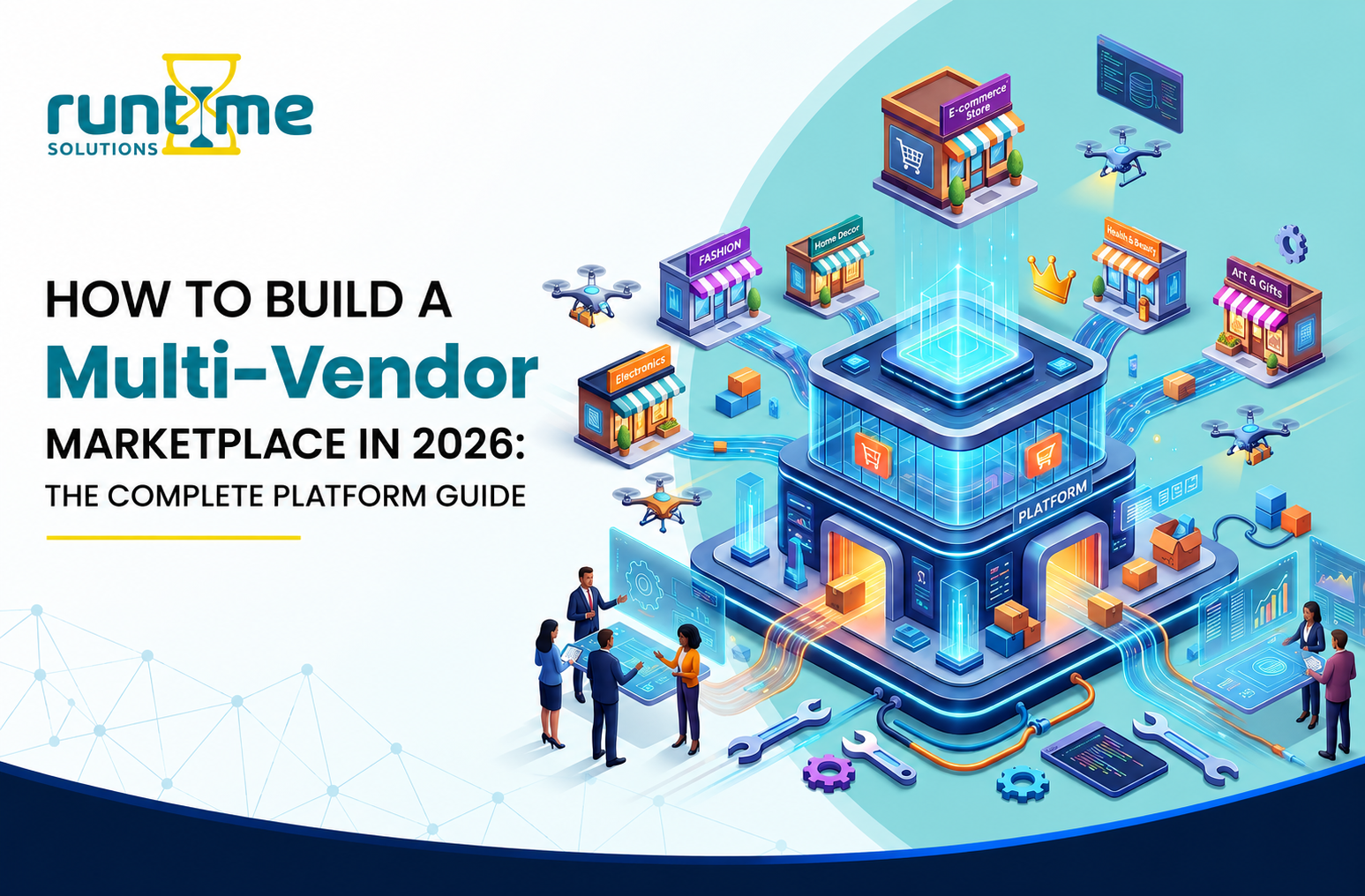
The essence of the concept of a multi-vendor market lies in the fact that it represents an interactive platform on the Internet in which several independent vendors offer their goods or services to buyers.
In contrast to conventional one-vendor e-shops, the market owner does not necessarily have a product stock because he only creates a digital environment and ensures transactions, payment processing, and buyer attraction. The market earns its money by means of commissions, listing, subscription plans, and other forms of premium sellers’ promotion.
Why Multi-Vendor marketplaces are booming in 2026
The changing dynamics of 2026 have seen a rise in the demand for cutting-edge e-Commerce marketplace solutions. These factors are mainly responsible for fueling this rise:
1. Headless and API-First Commerce
The monolithic eCommerce approach has long gone out of vogue and is now being replaced with a more decoupled, headless commerce structure. This allows operators to offer lightning- fast, highly customizable shopping experiences that span all platforms from web-based services through mobiles, smartphones, and connected devices.
2. AI-Fueled Personalization & Automation
Now that artificial intelligence has become central to developments in 2026, current websites use artificial intelligence in their activities, from mapping products in their catalog and setting prices to protecting against fraud and recommending products. Vendors also utilize AI technology to quickly generate optimized product pages.
3. Hyper-Local & Mobile-First Approach
People expect immediate satisfaction today. The need for hyper-local online marketplaces has risen exponentially, with consumers demanding same-day or even 2-hour delivery services. Thus, developing a multi-vendor app has become essential to cater to mobile-first buyers who use apps over websites.
Must-Have Features of a Modern Multi-Vendor Platform
For creating a competitive marketplace platform, there is a need to cater to three different user groups: the administrator of the marketplace, the seller, and the final buyer.
- Administrator’s Dashboard (Control Room)
- Onboarding Sellers/KYC Processes: Automated solutions for verifying sellers in order to approve them while complying with local laws.
- Commission System: Customizable commission system (flat fee, percentage, and tiered-based), depending upon requirements.
- Automatic Payout/Escrow Services: Split payment engine for automatically transferring payments to sellers after deducting commissions.
- Content Moderation: Automated tools using AI technologies for the moderation of content prior to its approval for publication.
- Seller’s Interface (Toolbox)
- Seller Self-Service Dashboard: Where sellers have all the necessary options for viewing statistics, managing inventory, and processing shipments and payments.
- Bulk Product Upload/Download Capabilities: Automatic bulk uploads and downloads via API or CSV/XML file formats.
- Promotions Engine: Where sellers have the option of running promotions and discounts on products within the marketplace.
- Shipping Settings/Custom Rates: Shipping settings for integrating with local shipping partners and printing shipping labels.
- The Customer Experience (The Front End)
- Advanced Search & Filter: Semantic search engines that recognize the user’s intent, combined with quick and multi-dimensional filtering features.
- Unified Checkout w/Multi Vendor Cart: Making it possible for users to order from various vendors within one checkout, with dynamic shipping fees per vendor.
- Vendor Rating & Reviews: Purchase verification review systems that ensure the maintenance of community standards.
- Seamless Payments: localization, wallets, pay later options, and multicurrency payments.
The Tech Stack: Architecting for speed, security, and scalability
It should be clear from the outset that technology choices will influence the speed of the platform, cost of maintenance, and scalability. Using the MACH architecture (Microservices, API-first, cloud-native, and headless) to build a contemporary online marketplace platform can offer various advantages.
- Front End Framework – React.js, Next.js, Vue.js, or Nuxt.js (server-side rendering with better SEO)
- Mobile Application Development – Flutter or React Native (economic cross-platform development solution)
- Back End & APIs – Node.js, Python (Django/FastAPI), Go, and GraphQL (efficient data fetch)
- Database – PostgreSQL (transactional database), MongoDB (flexible catalog database) & Redis (caching database)
- Cloud Platform – AWS, Google Cloud, or Microsoft Azure (automated scaling using Docker and Kubernetes)
- Search Engine – Elasticsearch or Algolia (high-speed searching with auto-completion features)
Build vs. Buy: Choosing the Right Development Approach
One of the decisions you are going to make will be about how to develop your platform. The options available can be divided into three major groups:
- Ready-Made SaaS Marketplaces
- Building a platform with pre-built solutions like Sharetribe, CS-Cart, and Shopify (also with multivendor plugins added).
- Pros: Quick implementation and low costs at the outset.
- Cons: Limited customization opportunities, high transaction rates, and problems with migration.
- Open Source Solutions
- Customizing open-source solutions such as Magento (also known as Adobe Commerce) and WooCommerce.
- Advantages: Useful in managing software code and numerous plugins for various purposes.
- Disadvantages: Expensive to maintain, risk factors related to out-of-date software, and poor performance.
- Custom Headless Development (The 2026 Standard)
- Building your platform based on custom headless APIs with a unique frontend and a special backend commerce engine.
- Advantages: Endless scalability, fast loading pages, flexible design, and high security.
- Disadvantages: Higher development expenses initially and a long deployment process.
Step-by-Step guide to launch your Marketplace
However, apart from incorporating technology in your platform, you must have an approach too. You can create a market using such a structured process below:
Niching and Research Stage – MVP Development Stage – UX/UI Development Stage – Core Development Stage – Launch Stage
Step One: Identify the targeted market and value
It is pointless to attempt direct competition with a marketplace like Amazon from Day One. Rather, identify your vertical niche market (for example, an online marketplace only for sustainable building products or freelancing pet groomers in your local area). Focus on addressing a particular issue faced by both vendors and consumers.
Step Two: Identify the Platform’s Source of Revenue
Identify how the platform will generate revenue. Will the platform charge a flat percentage of sales made through the website, require monthly subscriptions by vendors to gain access to premium functionality, or adopt a mixed approach? However, remember to keep your prices affordable enough for novice vendors.
Step Three: Build MVP
One must never try to build a complete marketplace with all kinds of features at one go. Building an MVP with minimum functionalities like signing up for vendors, uploading products, a payment gateway, and an admin panel should be the focus to get user feedback.
Step Four: Ensure Security and Compliance
A marketplace needs a lot of personal and financial information from consumers and vendors. So, you need to make sure that your marketplace is fully secure by having advanced security measures in place.
How Runtime Solutions Accelerates Your Marketplace Journey
To effectively tackle the challenges of today’s multi-vendor marketplace development, one needs advanced technical skills, a clear vision, and agile development capabilities. As a reliable technology partner, Runtime Solutions assists companies in creating efficient marketplace platforms by leveraging state-of-the-art technology, as well as B2B industry knowledge and experience. Their development teams enable you to develop a headless commerce stack, customize a multi-vendor app, integrate external payment processors and ERPs, among other services. With the help of Runtime Solutions, you get a marketplace platform that not only works efficiently but is also optimized for organic traffic.
Conclusion: Ready to Build?
Markets would emerge as one of the most profitable ventures for generating high profits for yourself, owing to their profitable characteristics. As a mediator between the buyers and sellers, you would not have to be concerned about inventories, and hence your business would expand without many issues.
What matters most is finding the right niche, giving an emphasis on a quality user experience, and using technology that enables you to scale up your business effectively. All you need to do is give immense value to the customers, and the MVP approach will assist you in scaling up efficiently.
Ready to develop a successful marketplace? Contact our professionals at Runtime Solutions to learn more about our services and get your project underway!