
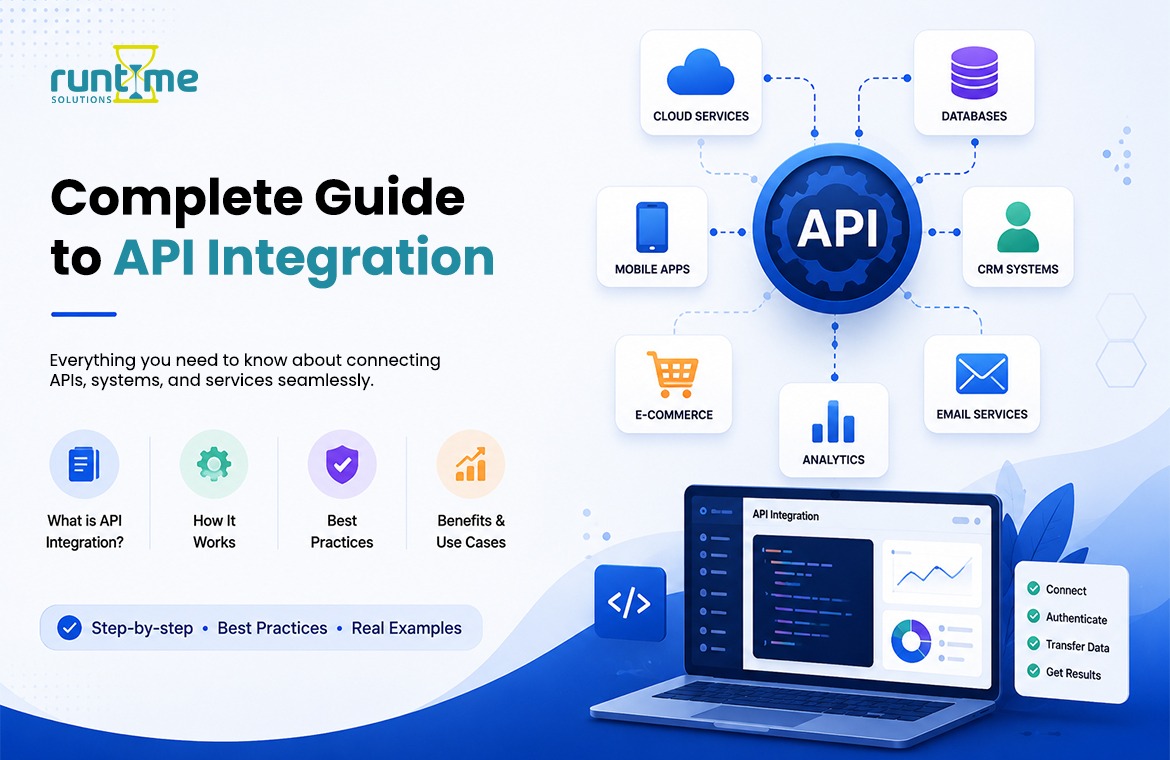
What Is API Integration?
API integration is the connection between two or more software applications through their APIs so that they can exchange data and perform tasks automatically without manual intervention. API stands for Application Programming Interface. An API is a contract between two pieces of software. It’s a way that one piece of software can ask another for data or functionality. Integration is the wiring up of those contracts . It is how systems work as one .
In practice, API integration is what allows your e-commerce store to send new orders to your accounting software, or have your CRM update itself when a customer pays, or have your app authenticate users through their existing accounts. Instead of a person exporting a spreadsheet from one tool and importing it into another the applications talk directly and the data moves on its own.
The result is an integrated software stack, not a disparate set of tools. When companies adopt more specialized applications – one for sales, one for support, one for billing, one for marketing – API integration is what prevents those applications from becoming data silos, each with a partial, out-of-date picture.
Why API Integration Matters
API integration delivers value that compounds as your software stack grows, and it does so across efficiency, accuracy, and capability.
Automation and efficiency.
Every manual data transfer between systems is time spent and an opportunity for error. Integration removes that work entirely: an order placed in one system appears in the next automatically, freeing staff from repetitive copy-paste and letting them focus on work software can’t do.
Data accuracy and a single source of truth.
When the same information lives in several disconnected tools, the copies drift apart and no one knows which is correct. Integration keeps systems synchronized so a change in one place propagates everywhere, giving the whole organization one consistent view of a customer, an order, or an inventory count.
Extended functionality without rebuilding.
Integration lets you add capabilities by connecting to services that already do the job well — payments, maps, messaging, identity, analytics — instead of building each feature from scratch. This is faster, cheaper, and more reliable than reinventing infrastructure that specialized providers have already perfected.
Better customer experience.
Connected systems enable experiences that isolated ones can’t: real-time order tracking, instant payment confirmation, personalized recommendations drawn from behavior across tools. The seamlessness customers now expect is, underneath, a web of API integrations.
The trade-off is engineering effort. Integrations must be designed, built, secured, and maintained as the connected services evolve — and a poorly managed integration layer becomes fragile and expensive rather than an asset.
How API Integration Works
At its core, an API integration is a structured conversation between a client (the system making the request) and a server (the system responding). The exchange follows a predictable cycle.
- Request: The client sends a request to a specific API endpoint — a URL representing a resource or action — using an HTTP method that signals intent: GET to retrieve data, POST to create, PUT or PATCH to update, DELETE to remove.
- Authentication: The request carries credentials — an API key, a token, or an OAuth grant — that prove the client is authorized to make it. The server rejects anything unauthenticated or lacking permission.
- Processing: The server validates the request, performs the requested operation against its data or systems, and assembles a response.
- Response: The server returns the result, typically as a JSON payload, along with an HTTP status code indicating the outcome — 200 for success, 400 for a bad request, 401 for unauthorized, 404 for not found, 500 for a server error.
- Handling: The client parses the response, maps the returned data into its own format, and acts on it — storing it, displaying it, or triggering the next step.
Every integration is built from repetitions of this loop. The engineering work lies in handling the loop robustly: authenticating correctly, mapping data accurately between two systems that structure it differently, retrying gracefully when a request fails, and respecting the limits the other system imposes.
Types of APIs
Integrations differ significantly depending on the API style involved, and the four dominant styles have distinct strengths.
REST (Representational State Transfer) is the most common style for web APIs. It’s stateless, organizes everything around resources addressed by URLs, uses standard HTTP methods, and typically exchanges JSON. Its simplicity and ubiquity make it the default choice for most modern integrations.
SOAP (Simple Object Access Protocol) is an older, stricter protocol that uses XML and enforces a rigid message structure. It’s more verbose than REST but offers built-in standards for security and reliability, which keeps it in use across enterprise, financial, and legacy systems where those guarantees matter.
GraphQL is a query language for APIs that exposes a single endpoint and lets the client specify exactly which fields it wants in a single request. This eliminates over-fetching (receiving more data than needed) and under-fetching (having to make multiple requests), which is valuable for complex applications and bandwidth-constrained clients like mobile apps.
gRPC is a high-performance framework that uses Protocol Buffers — a compact binary format — over HTTP/2. It’s faster and more efficient than text-based APIs, which makes it a strong fit for internal communication between microservices, though it’s less suited to public-facing browser integrations.
Webhooks invert the usual model. Rather than the client repeatedly asking the server for updates, the server pushes data to the client automatically when an event occurs, by sending a request to a callback URL the client registered. This event-driven approach is far more efficient than constant polling for near-real-time updates like payment confirmations or shipment status changes.
API Integration Approaches: Build, Buy, or Blend
Beyond the API style, the bigger decision is how you connect systems — and the right approach depends on how many integrations you need and how much engineering capacity you have.
Point-to-point integration connects two systems directly with custom code. It’s simple and fast for a single connection, but it doesn’t scale: connecting many systems this way produces a tangle of one-off links that each break independently and multiply maintenance as the count grows.
Middleware and Enterprise Service Bus (ESB) introduce a central layer that all systems connect to, rather than to each other. This decouples systems and centralizes routing and transformation logic, reducing the point-to-point sprawl — at the cost of running and maintaining the middleware itself.
iPaaS (Integration Platform as a Service) is a cloud service that provides pre-built connectors and a visual interface for wiring applications together, often with little or no code. Platforms in this category let teams assemble common integrations quickly without building each connection from scratch, which suits standard app-to-app workflows and organizations without deep engineering resources.
Custom API integration means engineers build and maintain the connections directly against each system’s API. It’s the most flexible and powerful approach — essential when integrations involve non-standard systems, complex data transformations, or logic no connector supports — but it requires the engineering time and expertise many businesses don’t have in-house.
The honest framing is build-versus-buy. iPaaS is efficient for common, standardized connections; custom integration is the right call when the connection is business-critical, non-standard, or has to behave in a way off-the-shelf connectors can’t. Many organizations blend the two.
Authentication and Security in API Integration
Because integrations move data between systems, how they authenticate and secure that exchange is not optional detail — it’s the difference between a safe integration and a breach.
API keys are simple secret strings that identify and authorize a client. They’re easy to use but must be kept confidential; an exposed key grants whoever holds it the same access you have.
OAuth 2.0 is the standard for delegated access. It lets a user grant an application permission to act on their behalf — accessing their data on another service — without ever sharing their password, issuing scoped, revocable tokens instead. It’s what powers “sign in with” flows and most third-party access to user accounts.
JWT (JSON Web Token) is a compact, self-contained token format that carries claims about the client and can be verified without a database lookup, commonly used to maintain authenticated sessions across requests.
Beyond authentication, secure integrations encrypt data in transit (via HTTPS/TLS), validate and sanitize inputs, store credentials in secure vaults rather than in code, and grant each integration only the minimum permissions it needs. Most serious integration incidents trace back to leaked credentials or missing encryption, not exotic attacks.
Glossary of API Integration Terms
API (Application Programming Interface) — A defined contract that lets one software system request data or functionality from another.
API Gateway — A management layer that sits in front of APIs, handling routing, authentication, rate limiting, and monitoring for requests passing through.
API Integration — The connection of two or more applications via their APIs so they exchange data and trigger actions automatically.
API Key — A secret string used to identify and authorize a client making API requests.
Authentication — Verifying the identity of the system or user making a request.
Authorization — Determining what an authenticated system or user is permitted to do.
Bearer Token — A credential included in a request header that grants access to whoever holds it, commonly used with OAuth.
Batch Processing — Handling data in grouped sets on a schedule rather than one record at a time in real time.
CORS (Cross-Origin Resource Sharing) — A browser security mechanism that controls which external domains a web page may call.
Endpoint — A specific URL that represents a resource or action an API exposes.
ESB (Enterprise Service Bus) — A centralized middleware layer that routes and transforms messages between connected systems.
ETL (Extract, Transform, Load) — The process of pulling data from a source, reshaping it, and loading it into a destination.
Exponential Backoff — A retry strategy that progressively increases the wait between failed attempts to avoid overwhelming a struggling server.
GraphQL — A query language and API style that exposes a single endpoint and lets clients request exactly the fields they need.
gRPC — A high-performance API framework using binary Protocol Buffers over HTTP/2, suited to internal microservice communication.
Idempotency — A property whereby making the same request multiple times produces the same result, preventing duplicate side effects from retries.
iPaaS (Integration Platform as a Service) — A cloud platform offering pre-built connectors and low-code tools to integrate applications.
JSON (JavaScript Object Notation) — A lightweight, human-readable data format that is the dominant payload format for modern APIs.
JWT (JSON Web Token) — A compact, self-contained, verifiable token used to carry authentication claims between systems.
Middleware — Software that sits between applications to connect them and mediate their communication.
OAuth 2.0 — The standard framework for delegated, scoped, revocable access without sharing passwords.
OpenAPI (Swagger) — A specification for describing REST APIs in a standard, machine-readable format that documents endpoints and generates client code.
Pagination — Splitting large result sets across multiple responses so no single request returns an unmanageable volume of data.
Payload — The actual data carried in a request or response body.
Polling — Repeatedly requesting a server for updates at intervals, in contrast to event-driven webhooks.
Rate Limiting — A cap the server enforces on how many requests a client may make in a given window, protecting it from overload.
REST (Representational State Transfer) — The dominant stateless, resource-oriented API style built on standard HTTP methods.
SDK (Software Development Kit) — A packaged library that wraps an API to make integrating with it easier in a given programming language.
SOAP (Simple Object Access Protocol) — An older, strict, XML-based protocol with built-in security standards, common in enterprise and legacy systems.
Webhook — A reverse API where the server pushes data to a client’s callback URL when an event occurs, rather than waiting to be polled.
XML (eXtensible Markup Language) — A structured, tag-based data format used by SOAP and many legacy integrations.
Common API Integration Challenges
Integrations fail in recurring, predictable ways, and knowing the failure modes is most of avoiding them.
Authentication and token expiry. Credentials expire, tokens need refreshing, and OAuth flows have many moving parts. Integrations that don’t handle token refresh gracefully break silently the moment a token lapses.
Rate limits and throttling. Every external API caps how often you can call it. Integrations that ignore those limits get throttled or blocked during peak load — exactly when they’re needed most. Respect the documented limits and use exponential backoff on retries.
Breaking changes and versioning. The systems you integrate with evolve, and an unversioned change on their side can break your integration without warning. Pin to specific API versions where possible and monitor provider changelogs.
Weak error handling. Networks fail and requests time out. An integration that assumes every call succeeds loses data and corrupts state when one doesn’t. Robust integrations retry transient failures, handle permanent ones deliberately, and log everything for diagnosis.
Data mapping mismatches. Two systems almost never structure the same information identically — different field names, formats, date conventions, and required fields. Getting the transformation between them wrong is one of the most common sources of subtle, hard-to-trace integration bugs.
Security gaps. Hardcoded credentials, unencrypted traffic, and over-broad permissions turn an integration into an attack surface. Store secrets securely, encrypt in transit, and scope permissions to the minimum each integration needs.
No monitoring. An integration you can’t observe is one you’ll only notice has failed when a customer complains. Logging, alerting, and health checks turn silent failures into caught ones.
Conclusion
API integration is what separates software that works in isolation from software that works together — turning a collection of disconnected tools into a stack where data flows automatically, records stay in sync, and capabilities compound. Understanding the pieces covered here (the API styles, the integration approaches, the authentication models, and the failure modes that make integrations fragile) is what lets a team decide not just how to connect systems, but whether to build those connections in-house, buy them off the shelf, or have them built to fit.
That last decision is where most businesses get stuck: the systems clearly should be talking to each other, but building and maintaining reliable integrations takes engineering time and expertise that most teams don’t have to spare. Runtime Solutions builds custom software and API integrations for exactly that gap — connecting your CRM, ERP, payment gateways, and third-party platforms so information moves between them automatically instead of through manual exports and copy-paste. It’s core capability, not a side offering: Runtime built its own cloud-hosted learning management platform on a full API and third-party integration layer. If you have systems that should be connected but aren’t, talk to the Runtime Solutions team about scoping the integration.
Frequently Asked Questions
What is the difference between an API and API integration?
An API is the interface — the contract that defines how one system can request data or actions from another. API integration is the act of connecting systems through those interfaces so they actually exchange data and work together. The API is the doorway; integration is walking through it and wiring the two rooms together.
What is the difference between REST and SOAP?
REST is a flexible, lightweight architectural style using standard HTTP and usually JSON, favored for modern web and mobile integrations. SOAP is a stricter XML-based protocol with built-in security and reliability standards, still common in enterprise and legacy systems. REST is simpler and faster to work with; SOAP offers more rigid guarantees where they’re required.
What is an API endpoint?
An endpoint is a specific URL that an API exposes to represent a resource or action — for example, a URL to retrieve a list of customers or to create a new order. Each endpoint accepts particular request types and returns particular data, and integrating with an API means making requests to the right endpoints.
What is the difference between a webhook and an API call?
A standard API call is initiated by the client asking the server for something (pull). A webhook is initiated by the server, which pushes data to the client automatically when an event happens (push). Webhooks are far more efficient than repeatedly polling an API for updates, because the client is notified only when there’s actually something new.
When should a business use iPaaS versus custom integration?
iPaaS suits common, standardized connections between popular applications that its pre-built connectors already support, and teams without engineering capacity. Custom integration is the right choice when connections are business-critical, involve non-standard systems, require complex data transformation, or need behavior no off-the-shelf connector provides. Many organizations use both — iPaaS for the routine, custom builds for the strategic.
How is API integration kept secure?
Through strong authentication (API keys, OAuth, or tokens), encrypting all traffic with HTTPS/TLS, storing credentials in secure vaults rather than in code, granting each integration only the minimum permissions it needs, and validating inputs. Most integration breaches come from leaked credentials or unencrypted data, so those fundamentals matter more than any single advanced measure.