
Introduction
A morning rush in a modern office used to look like this – An employee swiping cards with a long queue of employees behind them, punching codes or signatures in a register. But today that image is changing and becoming obsolete. Now in it’s place a quiet revolution is unfolding at an office, one that is driven by biometric technology. As organizations grow or go hybrid and demand greater accountability, traditional attendance systems cannot keep up this pace.
Buddy punching, time theft, and manual errors cost businesses billions every year. According to the American Payroll Association, approximately 75% of businesses are affected by time theft and buddy punching. It costs U.S. Employers roughly $373 million annually. This creates an entry for biometric and facial recognition attendance systems. Biometric and Facial recognition are two of the most talked about solutions in the modern workforce management structure. Both solutions promise accuracy, automation and accountability. But both of them work differently, carry different risks and suit different workplace environments. So which one will actually be better suited for your office?
Understanding the Basics
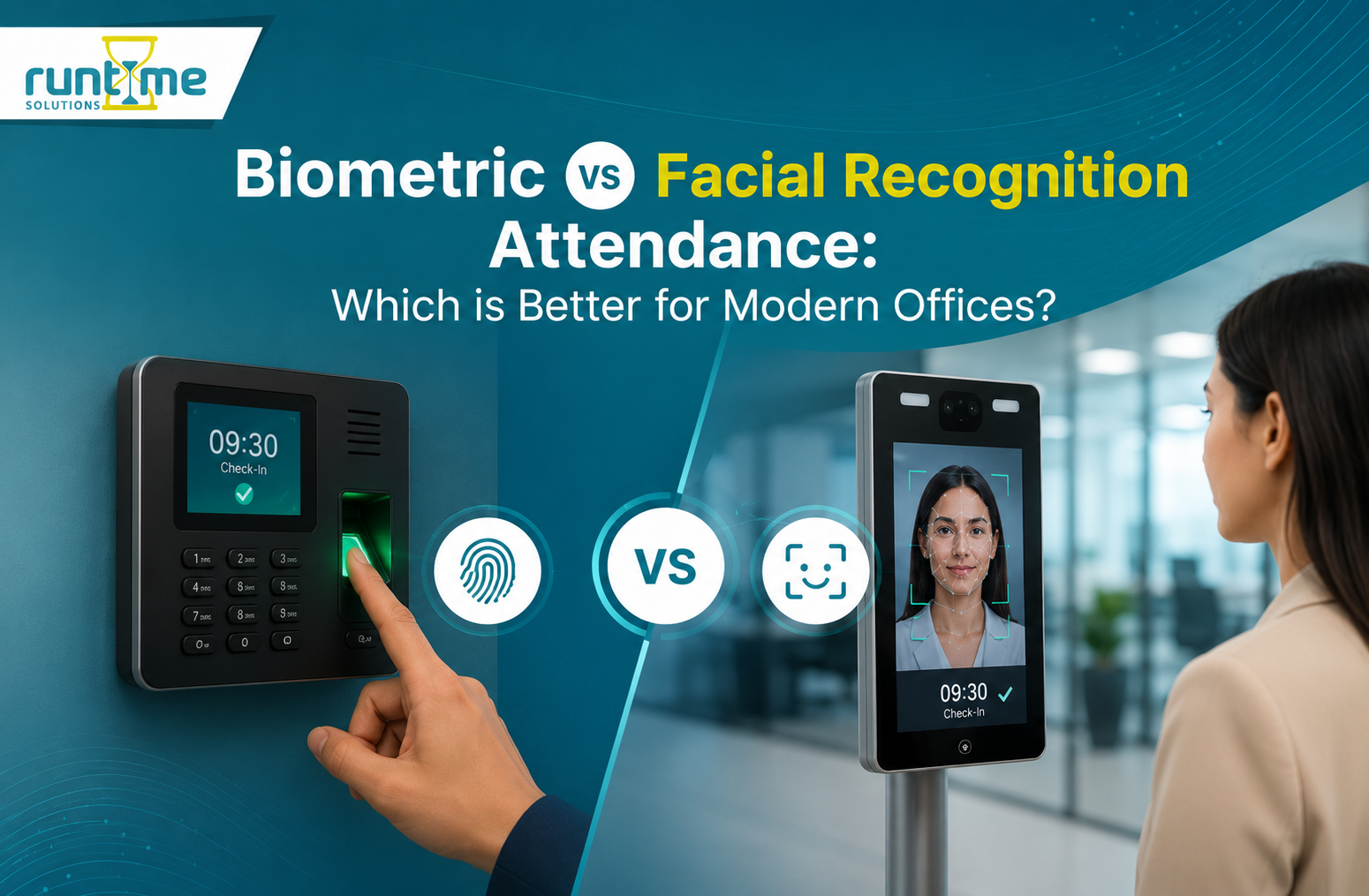
Before we compare them, it is important to clarify that facial recognition is counted technically as a subset of biometrics. However in attendance management context the two terms are commonly used to distinguish between traditional biometric systems, which rely on fingerprint scanners, iris recognition, hand geometry or vein pattern readers requiring physical contact and facial recognition systems which use AI-Powered cameras and computer vision algorithms to identify employees by scanning their facial geometry, which is often from a distance without any physical interaction.
Traditional biometric systems have been commercially widespread since early 2000s. In which Fingerprint scanners remain the most common, mapping unique ridge patterns with near instant result. Iris scanners are more sophisticated but require precise positioning. Vein scanners which capture patterns beneath the skin are extremely difficult to fool and are used in high security environments like data centers and government facilities. Facial recognition, by contrast follows a multi-step pipeline which is: detecting a face, normalizing it for lighting and angle, then extracting a unique facial vector and matching it against an enrolled database, all of which is typically completed under 0.5 seconds.
Head-to-Head Comparison
For any attendance management system accuracy is the most fundamental requirement. Fingerprint scanners typically achieve 99.9% accuracy under ideal situations but real world performance can dip when fingers are dry, scarred or worn which is a genuine concern for the employees in manufacturing or healthcare. According to NIST’s Face Recognition Vendor Testing (FRVT) program, the best facial recognition system algorithms have achieved false non-match rates which are as low as 0.1% but under controlled conditions. However, performance can vary based on the poor lighting, significant appearance changes and demographic factors. NIST’s own research has highlighted higher error rates for darker skinned individuals in some algorithms which raises important fairness concerns. On balance, both the technologies are highly accurate under optimal conditions but each has distinct environmental weakness.
Hygiene is a critical consideration after the COVID-19 pandemic which has fundamentally changed how a workplace thinks about shared surfaces. Every fingerprint scan requires physical contact with a shared sensor which causes a genuine infection vector that caused a lot of organizations to disable their fingerprint systems entirely during the pandemic. Facial Recognition has a clear advantage here. Employees are recognized simply by walking past a camera with zero physical contact. According to a Markets and Markets repost the contactless biometric market used to be valued at $16.7 billion in 2023 and is projected to grow to $47.2 billion by 2028 which is largely driven by the post pandemic demand for touchless solutions.
Cost is often the deciding factor for the HR and Operations teams. A commercial fingerprint terminal costs between Rs. 3,000 and Rs. 15,000 in India or $50 to $300 in the US which shows the affordability, reliability and easy to maintain nature of the terminal. Facial recognition systems are significantly more expensive, ranging from Rs. 25,000 to Rs. 2,00,000 or more per terminal with additional recurring costs for AI software licenses and cloud processing. However it is worth noting that these costs are falling rapidly due to AI hardware becoming cheaper. In terms of speed the facial recognition systems can identify individuals from up to five meters away, process multiple faces simultaneously and allow employees to walk through without stopping which helps in dramatically reducing congestion at peak entry times compared to one at a time fingerprint scanning.
Quick Comparison at a Glance
| Factor | Fingerprint Biometric | Facial Recognition | Winner |
| Accuracy | 99.9% | 99%+ AI Driven | Tie |
| Hygiene | Contact Required | Fully Contactless | Facial Recognition |
| Cost | Low | High | Traditional Biometric |
| Speed | 1-2 sec/person | Sub-Second, Multi-face | Facial Recognition |
| Security | Liveness Detection | 3D Depth + liveness | Tie |
| Privacy Risk | Lower | Higher | Traditional Biometric |
Privacy & Legal Considerations
This is the section that many vendors gloss over but it may be the most important one for the organizations operating in today’s regulatory environment. Biometric data is categorically different from other employee data. If an employee’s password is compromised then it can be changed. But if their fingerprint or facial geometry is stolen then it cannot be changed. This irreversibility is what makes biometric data uniquely sensitive under privacy laws worldwide.
Under the EU’s General Data Protection Regulation (GDPR) any biometric data used for identification is classified as Special Category Data under Article 9 which requires explicit employee consent and a Data Protection Impact Assessment before deployment. Non Compliance can result in fines up to €20 million. In India, the Digital Personal Data Protection Act of 2023 places significant obligations on organizations processing biometric data, requiring informed consent and data minimization while the detailed rules are still being finalized. In the United States, Illinois’s Biometric Information Privacy Act (BIPA) is the most stringent state law, with companies like Facebook and Google paying hundreds of Millions in settlements.
Facial recognition carries a greater privacy risk than traditional biometrics for one key reason which is, it can be operated without the subject’s knowledge. A camera can identify a face without the person ever touching a device or knowing they are being scanned. This passive surveillance capability has led to outright bans on facial recognition in public spaces in cities like San Francisco, Boston and Portland. In the workspace, employees must be fully informed and consented before any facial recognition system is deployed as this is not just an increasing ethical expectation but a legal requirement.
Which Industries Suit Each System?
The right choice of attendance management systems depends heavily on the nature of the workplace. The table below offers a practical guide based on operational requirements, workforce size and other environmental factors.
| Office/Industry | Recommended | Reason |
| Large Corporate | Facial Recognition | Speed, Frictionless entry, Scalability |
| Manufacturing & Factory floors | Vein / Iris Recognition | Fingerprints affected by manual labour |
| Healthcare & Hospitals | Facial Recognition | Hygiene critical: gloves impractical |
| SMBs | Fingerprint Recognition | Cost effective & easy to deploy |
| High Security Facilities | Vein / Iris Recognition | Maximum accuracy, spoof resistance |
| Hybrid / Remote | Mobile Facial Recognition | Works on devices, no hardware needed |
The Verdict: Which Is Better for Modern Offices?
After examining the accuracy, hygiene, cost, speed, security and privacy it is clear there is no single universal winner. Traditional biometric systems like fingerprint scanners do remain an excellent, cost effective and reliable choice for small to mid-sized businesses that need proven accuracy without heavy IT investments. They are mature, widely supported and work well in standard office environments and also without an internet connectivity.
Facial recognition systems represent the direction in which the industry is moving which is touchless, fast, scalable and increasingly intelligent. For large enterprises hygiene sensitive sectors and organizations investing in integrated workforce technology, they offer compelling advantages that traditional systems simply cannot match. Many forward thinking organizations are now adopting a hybrid approach which is: facial recognition at the main entrance for fast and frictionless bulk attendance capture and then fingerprint of iris scanning at restricted zones for high security access control and then mobile based facial recognition for remote or field employees. According to a Gartner report on workforce technology trends: by 2026 over 40% of large enterprises are expected to deploy multimodal biometric authentication systems.
The Future of Attendance Technology
The world of Attendance management is changing fast. Behavioural biometrics such as identifying people by their gait, typing style or movement are the next frontier with some campuses already piloting gait based identification using the standard CCTV. Mobile-first attendance through GPS tagged selfies on smartphones is gaining traction through platforms like Keka, DarwinBox and Zoho People, which are lightweight, hardware-free model well suited to hybrid workforces. Also emerging as a regulatory necessity are privacy-preserving biometrics where the matching is done on the device rather than in the cloud. According to IDC’s Worldwide Biometrics and Digital Identity Forecast, the biometrics industry is expected to grow at a compound annual growth rate (CAGR) of 22.3% through 2027.
Conclusion
Ultimately, the biometric vs face recognition attendance debate is not about which technology is better in theory, but which option is best for your employees, your business, and your future. There is no avoiding it; privacy and compliance will happen whichever side you choose. Before implementing any biometric solution, seek the advice of your legal team, conduct a data protection impact assessment, develop a clear biometric data policy and obtain informed employee consent.
The modern office is no longer simply a place where people come to work to but rather a dynamic, data rich environment that demands smarter, more humane and more accountable systems. Whether you choose fingerprints, faces or a thoughtful combination of both the goal remains the same which is to build a workplace where every person is seen, valued and accurately accounted for.
When choosing whether to adopt the traditional biometric methods or the newer facial recognition technique, organizations need to strike a balance between their specific requirements and the current state of affairs when it comes to security as well as employee satisfaction. Although fingerprints scanning is cost-effective and proven to work, the new trend towards using touchless, AI-powered facial recognition is fast becoming the norm in a high-tech working environment. Runtime Solutions plays an instrumental role by providing the technical know-how to facilitate implementation of the biometric pipelines into a cohesive and reliable system. They are committed to delivering seamless high-speed authentication alongside top-of-the-line data encryption and privacy policies.