
- What Is Generative Engine Optimization (GEO)?
- Why Does GEO Matter?
- Core Concepts and Terminology of GEO
- How Generative AI Search Functions
- How GEO Operates in the Real World
- A Practical GEO Workflow
- Advantages of Generative Engine Optimization
- Real-World Use Cases for GEO
- SEO vs. GEO
- GEO vs Conventional Search
- Best Practices for GEO Deployment
- Common GEO Mistakes to Avoid
- A Useful GEO Checklist
- Glossary of Key GEO Terms
- Conclusion
- Frequently Asked Questions
Imagine asking your friend a question and receiving a brief list of ten websites in return. Not very useful, right? You still need to click on the links, evaluate the data, and determine which response you can rely on. This is how traditional search has operated for many years. However, the experience is evolving due to AI-powered search.Nowadays, users can ask a comprehensive inquiry to ChatGPT, Google AI Overviews, Gemini, Perplexity, or other AI technologies and get a conversational response practically immediately. Rather than just displaying a list of links, the response might incorporate data from other sources. So, how can you ensure that your website is regarded as one of those reliable sources?
Generative Engine Optimization, or GEO, can help with it.
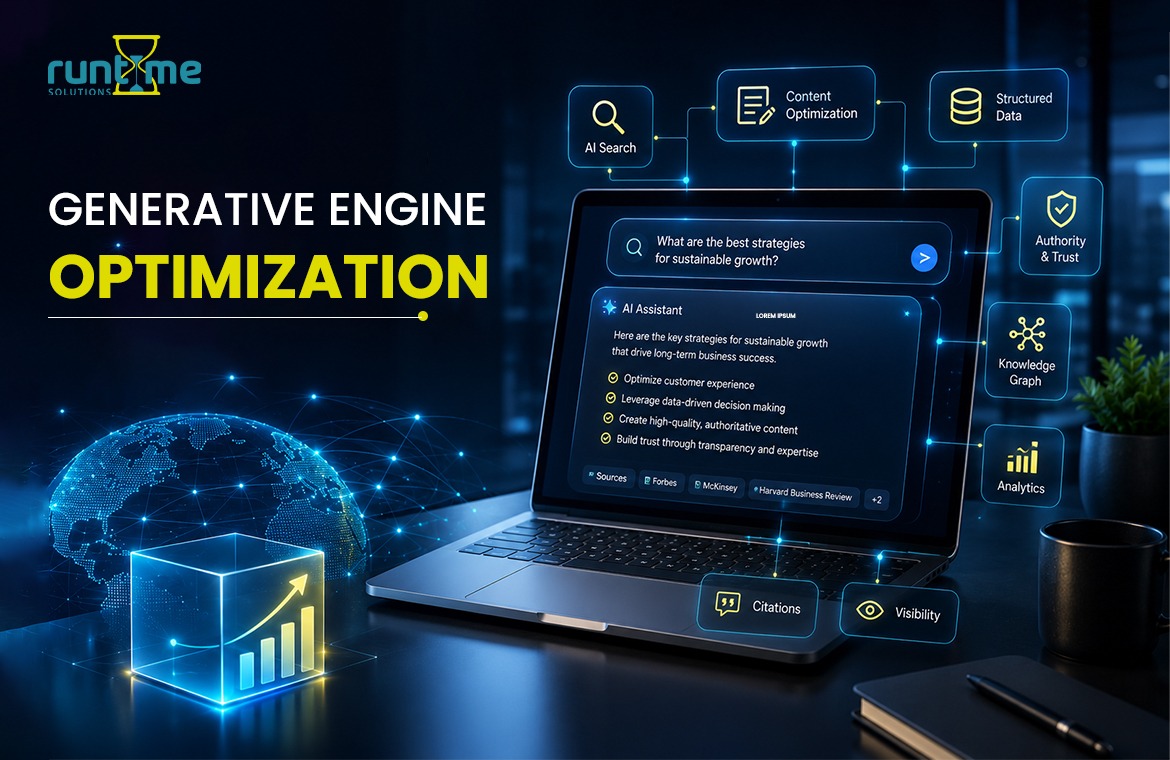
A new strategy for increasing content visibility in AI-generated responses is called Generative Engine Optimization. While it builds on many of the SEO concepts, it emphasizes content that is easy for AI systems to comprehend and utilize, as well as places greater importance on clear responses, context, authority, structured information, and freshness.This comprehensive tutorial will explain what GEO is, how generative search functions, how it differs from standard SEO, the fundamental ideas behind it, useful optimization techniques, typical errors, real-world applications, and the vocabulary you should be familiar with. Alright, let’s go!
What Is Generative Engine Optimization (GEO)?
Generative Engine Optimization (GEO) is the practice of creating and structuring digital content so that generative AI systems and AI-powered search experiences can understand, retrieve, summarize, and potentially reference that content when answering user questions.Traditional SEO is largely concerned with helping webpages appear prominently in search results. GEO takes the next step: it considers what happens when the search experience itself generates the answer.
For example, a user might search for “best AI chatbot for an ecommerce website.” A traditional search engine may return a page of results. A generative engine may instead explain what an ecommerce chatbot does, list useful features, compare options, and cite or mention sources it used.
The goal of GEO is therefore not simply to rank for a keyword. It is to make your content useful enough, clear enough, and trustworthy enough that an AI system can confidently use it as a source.The magic is in the shift from keywords to meaning. A good GEO strategy still uses relevant keywords, but it does not depend on repeating the same phrase again and again. It explains the topic thoroughly, answers real questions, provides context, and makes important facts easy to identify.GEO is especially relevant for brands that publish educational content, product information, research, comparisons, FAQs, documentation, and other resources that people may discover through AI-assisted search.
Why Does GEO Matter?
Search behaviour is changing. People are increasingly comfortable asking AI systems complete, conversational questions rather than typing two or three keywords into a search box.Instead of searching for “CRM software,” a user might ask, “Which CRM is suitable for a small B2B company that needs lead tracking and simple automation?” That question contains intent, context, and constraints. Generative AI is designed to understand this kind of request.
This creates a new visibility opportunity for businesses. Your website does not only need to compete for a position on a results page. Its content may also need to be understandable and useful to systems that assemble answers from multiple sources.GEO does not mean SEO is dead. Far from it. Search engines still crawl, index, and rank webpages, and traditional SEO remains important. GEO is better understood as an additional layer that prepares content for AI-driven discovery.
The strongest approach is to create content that works for both humans and machines: useful enough for people to read, structured enough for search engines to understand, and clear enough for AI systems to retrieve and summarize.
Core Concepts and Terminology of GEO
Before we go any further, let’s get familiar with the building blocks of GEO. Once these ideas are clear, the rest of the strategy becomes much easier to understand.
Generative Engine
A generative engine is an AI-powered system that can interpret a user’s question and generate a natural-language response. Depending on the platform, it may rely on trained knowledge, retrieve current information, search the web, or combine several sources before producing an answer.
AI Search
AI search refers to search experiences that use artificial intelligence to understand queries and provide synthesized answers. Instead of requiring users to open several websites, an AI search experience may summarize the information directly.
Citation
A citation is a reference or link to a source used to support an AI-generated answer. Citations are valuable because they give users a way to verify information and allow publishers to receive visibility within an AI response.
Search Intent
Search intent is the reason behind a user’s query. Someone searching “what is GEO” has informational intent, while someone searching “GEO agency pricing” may have commercial intent. Understanding intent helps you create content that actually answers the user’s need.
Semantic Search
Semantic search focuses on the meaning and context of a query rather than matching exact words. This is important for GEO because AI systems can recognize that different phrases may refer to the same concept.
Large Language Model (LLM)
A Large Language Model is an AI model trained on large amounts of language data so it can understand and generate text. Many modern generative AI applications are powered by LLMs.
Retrieval-Augmented Generation (RAG)
Retrieval-Augmented Generation, or RAG, is a method in which an AI system retrieves relevant information from an external source before generating an answer. This can help ground responses in current or specific information rather than relying only on a model’s general training.
Structured Data
Structured data is information added to a webpage in a standardized format that helps search engines understand what different parts of the page represent. Schema markup is one common implementation.
Topical Authority
Topical authority describes the depth and consistency of expertise a website demonstrates around a subject. Publishing one article about a topic is useful; building a connected library of genuinely helpful resources demonstrates much deeper coverage.
How Generative AI Search Functions
So how does a search experience driven by AI translate a query into an answer? The precise ranking and retrieval procedures are not entirely available, and several sites employ various systems. Nonetheless, a straightforward explanation of the overall workflow is possible.
Step 1: The user poses a query. The query can be brief, conversational, in-depth, or include multiple conditions.
Step 2: The query is interpreted by the system. Instead of depending solely on precise keyword matches, it determines the subject, intent, entities, and context.
Step 3: Relevant data is obtained. Web search, databases, knowledge sources, indexed material, and other information repositories may be involved, depending on the platform.
Step 4: Relevant sources are assessed. Information’s usefulness to the response can be influenced by a number of signals, including freshness, structure, authority, quality, and relevance.
Step 5: An answer is produced by the system. The AI creates a natural-language response by combining pertinent data. Certain systems offer source links or citations.For this reason, producing a single, extraordinary line that an AI will quote is not the goal of GEO. It involves establishing an information environment that is simple to find, comprehend, validate, and utilize.
How GEO Operates in the Real World
What is the practical application of all this theory, then? Let’s go over a basic example.
Consider a business that offers customer assistance software. Product pages, integration documentation, pricing details, case studies, and a help center are all included on its website.”What should a growing e-commerce business look for in customer-support software?” a prospective client queries an AI tool.
The AI might search for sources that address customer service workflows, automation, integrations, e-commerce support, and similar subjects. The generated response may benefit from a concise guide clarifying those topics on the software company’s website, complete with reliable material and real-world examples.The user’s specific sentence was not the only thing the organization optimized. Rather, it has created a helpful resource centered on the more general subject.The core of GEO is to produce content that addresses the queries your audience is posing, as well as any similar queries they might have in the future.
A Practical GEO Workflow
Step 1: Identify important customer questions. Start with sales calls, support tickets, search queries, FAQs, community discussions, and conversations with customers.
Step 2: Group questions by topic. Do not create disconnected articles for every tiny keyword. Build topic clusters that cover a subject from several useful angles.
Step 3: Create authoritative resources. Explain concepts clearly, provide examples, cite reliable sources where appropriate, and add original insight instead of simply rewriting existing pages.
Step 4: Make answers easy to extract. Use descriptive headings, concise definitions, tables, lists, examples, and FAQs.
Step 5: Keep information current. Update statistics, product details, examples, and industry guidance as the subject changes.
Step 6: Connect related content. Internal links help readers and search systems understand how your resources relate to each other.
Step 7: Measure and improve. Monitor organic visibility, referrals, brand mentions, customer questions, and the performance of your content. GEO is an ongoing process, not a one-time technical task.
Advantages of Generative Engine Optimization
GEO matters because it can support visibility at a point where people are changing how they discover information. Here is what businesses can gain.
Greater Brand Visibility
A brand can appear in an AI-generated answer even when the user does not begin by searching for that brand. Being mentioned or cited in a useful response can introduce the business to people earlier in the decision-making journey.
Stronger Content Quality
GEO encourages companies to create content that is genuinely useful. Direct answers, clear explanations, current information, examples, and supporting evidence improve the experience for readers as well as AI systems.
Better Topical Authority
A structured library of high-quality content can establish a business as a knowledgeable source in its industry. This is valuable beyond AI search because it also supports traditional organic visibility and customer trust.
Future-Ready Search Strategy
Search will continue to evolve. A content strategy built around helpful information, clear structure, authority, and user intent is more adaptable than one built around a narrow set of ranking tricks.
Improved User Experience
GEO-friendly content is generally easier for people to scan and understand. Clear headings, concise answers, comparison tables, examples, and FAQs reduce the effort required to find information.
Real-World Use Cases for GEO
GEO is not just for SEO teams. It can help any organization that relies on people finding information online. Let’s explore where it can have the biggest impact.
Technology and SaaS
Software firms can create product guides, integration documentation, feature explanations, comparative pages, troubleshooting tools, and use-case information. Comprehensive documentation might offer helpful source information when people query AI about a software issue.
Additionally, a SaaS provider can create topic clusters centered on the issues that its product resolves. Guides regarding ticket management, omnichannel support, chatbot deployment, customer happiness, support analytics, and helpdesk automation, for instance, could be published by a customer support platform. Instead than depending solely on one promotional page, these resources collectively show expertise.
Ecommerce
Product details, buying guides, comparison sites, shipping information, return policies, and FAQs may all be optimized by e-commerce companies. AI systems can comprehend what a product is, who it is intended for, and how it stacks up against alternatives with the aid of clear product data.
Healthcare
Carefully examined instructional materials, service details, patient FAQs, and appointment scheduling can be published by healthcare institutions. Businesses should steer clear of unsubstantiated medical claims and instead rely on certified experts and reliable sources because accuracy and confidence are particularly crucial in this situation.
Education
Course guides, admissions information, scholarship resources, career guides, and educational explainers can be produced by universities, schools, training providers, and edtech firms. These resources help address issues children and parents increasingly ask through AI tools.
Finance
Financial publishers, banks, insurers, and fintech businesses can provide clear explanations of complicated subjects including credit, savings, insurance, loans, and financial planning. Accuracy and source quality should be prioritized because financial information can have major repercussions.
Professional Services and B2B
GEO can be used to improve service sites, industry research, case studies, whitepapers, comparative guides, and instructional content by consultancies, agencies, law firms, technology suppliers, and other business-to-business companies.
SEO vs. GEO
Although they are closely related, GEO and SEO are not the same. Knowing the difference helps firms avoid considering GEO as a whole separate marketing discipline.
SEO traditionally focuses on improving a webpage’s visibility in search results. Important factors include crawlability, user experience, content quality, technical health, linkages, and keywords.
GEO focuses on how generative systems can comprehend and utilize content. Direct responses, context, semantic linkages, source credibility, structure, freshness, and the capacity of AI systems to extract valuable information are all given more weight.
Consider it this way: SEO makes it easier for you to compete for a search result. GEO makes you valuable enough to contribute to a solution.
Thus, the two approaches ought to complement one another. A poorly designed website will have trouble with both crawling and comprehension. Both traditional and AI-driven discovery are better supported by a website that is quick, easy to access, authoritative, and provides high-quality information.
GEO vs Conventional Search
“Which webpages should I show for this query?” is a common question in traditional search. “What information should I use to answer this person’s question?” is a broader question posed by a generative experience.
The way content should be written is altered by this distinction. A page that solely focuses on a term might not offer sufficient background. Both humans and AI have more work to do when a page provides a clear explanation of the subject, provides answers to relevant queries, backs up assertions, and logically arranges the data.
Best Practices for GEO Deployment
Are you prepared to make your website more search engine friendly? To create a solid foundation, adhere to these guidelines.
Begin with user inquiries
Avoid starting with AI. Start with your audience. Determine what consumers genuinely want to know, then create content that addresses those needs. Useful questions can be found in sales calls, support tickets, customer reviews, forums, search recommendations, and internal FAQs.
Respond to the Primary Question First
Give the definition close to the start of your post if it is about “What is GEO?” Don’t force readers to read five background paragraphs before responding. People can benefit from direct responses, and systems can recognize them more easily.
Create Topic Clusters
Just because a keyword tool displays hundreds of variations doesn’t mean you should make hundreds of thin pages. Create a logical content architecture with solid core resources and supplementary pages. To make the connections between topics obvious, link related articles together.
Use Clear Headings
The contents of a section should be explained in the headings. An ambiguous header like “Why This Matters” is less helpful than one like “Benefits of GEO.” Clear headers facilitate the scanning of lengthy text and aid in the identification of information portions by systems.
Include Evidence
Use reliable sources, original facts, examples, and, when appropriate, professional comments when making claims. Saying “research shows” is not enough to build trust. Give readers the source of any significant statistics.
Maintain Updated Information
Plan reviews for pages that include evolving data, product details, laws, costs, or technological advancements. Changing an article’s publication date is only one aspect of updating it; you need also make sure the content is still accurate.
When appropriate, use structured data.
Search engines can better comprehend entities and page kinds with the aid of schema markup. Instead of taking the place of clear content, it should enhance it. Poor content cannot become an authoritative source by adding markup.
Create Internal Connections
Make connections between relevant items so that readers can easily transition from general subjects to specific resources. Additionally, internal linking facilitates the communication of the content structure of your website.
Ensure that the website is accessible
Both the general public and pertinent search systems should have technical access to important content. Discoverability may be hampered by slow pages, poor navigation, blocked resources, and inaccessible content.
Prioritize writing for people.
People will notice if an article seems to have been produced just to manipulate an algorithm. Content that is helpful should sound straightforward, confident, and natural. Instead of making your material more robotic, GEO should make it more useful.
Common GEO Mistakes to Avoid
Although GEO is still developing, there are already a number of errors that are simple to spot.
Stuffing Keywords
Unnaturally using the same term repeatedly does not increase the authority of the article. Cover the subject in detail and utilize terminology that your audience is accustomed to.
Producing Content Just for AI
Your audience is still human. It is not a good idea to use content that is technically simple for computers to understand but difficult for people. Prioritize usability and clarity.
Publication of Thin Content
For a straightforward query, a brief definition could be sufficient, while complex topics require context. A shallow page is unlikely to become the best source if rivals offer examples, comparisons, use cases, and supporting data.
Ignoring Search Intent
A sales pitch is not what someone seeking a definition wants. A thorough comparison may be necessary for someone comparing products. Align the material with the query’s objective.
Making Use of Outdated Data
Freshness is especially crucial for issues that move quickly when using AI search. Examine previous articles instead of letting them subtly become erroneous.
Making Unfounded Allegations
Steer clear of hyperbolic claims like “AI always chooses authoritative websites” until you have evidence to back them up. Be specific about what is likely, what is known, and what differs depending on the platform.
Ignoring Human Knowledge
Content produced by AI is simple to create. Because they are more difficult to duplicate, original experience, expert evaluation, private data, case studies, and first-hand insights can significantly increase the value of material.
A Useful GEO Checklist
Prior to releasing your next piece, consider:
- Does the page provide a clear response to a user query?
- Is it simple to find the main answer?
- Are the headings logical and descriptive?
- Does the writing use straightforward, everyday language?
- Does the page offer examples or real-world context?
- When necessary factual statements are backed up?
- Is the data up to date?
- Does the page provide links to pertinent sources of support?
- Are search engines able to retrieve vital content?
- Would the page actually be helpful to a human reader?
You already have a solid basis for GEO if you said “yes” to the majority of these questions.
Glossary of Key GEO Terms
Here’s your cheat sheet for the critical GEO vocabulary.
AI Overview: An AI-generated summary presented within a search experience, designed to answer a query directly while potentially linking to supporting sources.
AI Search: A search experience that uses artificial intelligence to interpret queries and generate or summarize answers.
Answer Engine: A system designed to provide direct answers to questions rather than simply returning a list of webpages.
Citation: A reference or link to a source used to support information in an AI-generated answer.
Crawling: The process of discovering and accessing webpages so their content can be processed by search systems.
Generative Engine Optimization (GEO): The practice of making content easier for generative AI systems to understand, retrieve, and reference.
Hallucination: An AI-generated statement that is incorrect, fabricated, or unsupported by reliable information.
Indexing: The process of storing and organizing discovered content so it can be retrieved later.
Knowledge Base: A structured collection of information, documents, FAQs, or other resources used to answer questions.
Large Language Model (LLM): An AI model trained on large quantities of language data to understand and generate text.
Natural Language Processing (NLP): Technologies that help computers process and understand human language.
Prompt: The question, instruction, or input given to an AI system.
RAG (Retrieval-Augmented Generation): A technique that retrieves relevant external information before generating an answer.
Schema Markup: Structured data added to a webpage to help machines understand its content and entities.
Semantic Search: Search that focuses on meaning and intent rather than exact keyword matching.
Conclusion
Businesses’ perspectives on online visibility are evolving as a result of generative engine optimization. Getting a webpage to show up as a blue link is no longer the main goal of search. Making your content valuable enough for an AI system to retrieve, comprehend, summarize, and possibly cite is becoming more and more difficult.The good news is that the principles are surprisingly straightforward: provide answers to actual concerns, clearly explain concepts, maintain accurate and up-to-date information, arrange content logically, establish authority, and make your website accessible.
Finding a secret method that ensures a mention in ChatGPT or an AI Overview is not the goal of GEO. That cannot be guaranteed by any ethical approach. Rather, the focus is on creating information that is worthy of being found and cited.
In summary, GEO enhances SEO, strong content is still crucial, authority and trust are still key, structure benefits both people and computers, and new information is necessary for issues that move quickly. As AI plays a larger role in how consumers find information, firms that start planning now will be in a stronger position.
Frequently Asked Questions
What is Generative Engine Optimization (GEO)?
The process of optimizing content so that generative AI systems and AI-powered search experiences can comprehend, retrieve, summarize, and possibly refer to it while responding to user inquiries is known as generative engine optimization.
Is SEO being replaced by GEO?
No, GEO enhances SEO. For crawling, indexing, rankings, technological stability, and organic visibility, SEO is still crucial. GEO emphasizes the comprehension and application of material in AI-generated responses.
What makes GEO crucial for companies?
Businesses must make their information discoverable and helpful in the context of the growing usage of AI technologies for product, service, and inquiry research. GEO assists in preparing material for that evolving search experience.
How are sources selected by AI search engines?
The precise systems are not entirely public and differ depending on the platform. Information’s usefulness to an AI-generated response can generally be influenced by relevance, content quality, authority, freshness, structure, and the connection between the source and the query.
Does GEO benefit from structured data?
Search engines can comprehend the type and meaning of content on a webpage with the use of structured data. It is a helpful technical layer, but it cannot make up for poor or ambiguous content.
Are keywords still important for GEO?
Yes, but the objective is not to repeat matches exactly. While context, semantic relevance, concise responses, and thorough coverage aid AI systems in comprehending the issue, keywords aid in the communication of subject matter.
What distinguishes GEO from AEO?
Traditionally, the goal of answer engine optimization, or AEO, has been to optimize material so that it directly responds to queries. Optimizing material for generative AI and AI-powered search experiences is referred to by the more general name “GEO.” There is much overlap between the two methods.