
- Marketplace Era Introduction
- Architecture Strategy: Monoliths or Headless Composability
- Master Data Management and Unified Catalog Orchestration
- The Complexities of Vendor Onboarding and Identity Governance
- Financial Architecture: Split Payments, Escrow, and Global Ledgering
- Logistics Orchestration, Multi-Warehouse Routing, and Fulfillment
- Operational Scalability, Security, and Worldwide Compliance
- Conclusion
How to Build a Multi-Vendor Marketplace in 2026: The Complete Platform Guide
Marketplace Era Introduction
The digital commerce market of 2026 has completely transformed the traditional conception of e-commerce transactions. The era of the solitary, single-branded online store has come to the end of its relevance and made way for flexible platforms that bring together different independent parties for business, cooperation, and development. Regardless of whether an entrepreneur or a startup founder and enterprise owner is involved, constructing a marketplace now demands more than duplicating the architecture of an online shopping center. Building a marketplace means designing a very responsive and well-integrated digital sphere capable of accommodating the needs of both independent sellers, modern consumers’ high expectations, and a marketplace operator itself. In order to build a profitable marketplace in the current world, a complete break with monolithic software development approaches should be made, and flexibility, scalability, automation, and compliance should be prioritized.
It is impossible to underestimate the enormity of a multi-vendor company until you get an inside glimpse into the inner workings of online trade. In a usual, single-seller shop, all logistics will be very simple. You deal with just one source of inventory that is always available for your own use. You control your own delivery schedule and perform all transactions through one merchant account, thus generating a steady flow of income. Once you decide to move towards becoming a multi-vendor online business, you take upon yourself huge responsibility for making your platform technically feasible. Your database becomes highly fragmented, as thousands of vendors are uploading their products in various formats, setting up individual shipment policies, having their own warehouses, and requiring immediate payment. No more UI design here, everything becomes deeply integrated into the backend processes, and only your initial decision about your architecture determines the future success of your venture.
It is essential to recognize that the true building block of the market is not based on any marketing strategies, but rather on the experiences that the suppliers themselves face when using the market platform. Traditionally, the process of introducing vendors into the system was an inefficient, slow, and tedious one with an infinite stream of email correspondence and manual use of customized Excel spreadsheets. In the modern-day digital environment, having an automated and advanced vendor onboarding system is the indispensable requirement that needs to be met. Today, merchants require a system that offers a self-service approach, which will allow them to authenticate themselves through the corporate registry, quickly customize their digital micro-stores, and seamlessly integrate their existing inventory software through webhooks. Your highest merchants will leave your onboarding process and move to a more agile competitor if it takes you several weeks to onboard them.
Architecture Strategy: Monoliths or Headless Composability
As the process of designing and constructing the marketplace moves into its next technical step, the fundamental question that needs to be addressed becomes whether to design everything anew from scratch or to use ready-made monoliths. For more than ten years, the traditional platforms were offering their rigid template model, which left the marketplace builder with no choice but to adjust the whole idea of operation to the limits imposed by the platform. The situation has dramatically changed in 2026. Instead, modern approaches to the construction of such platforms support headless and composable architectures. It means that the commerce engine operates independently from the front-end and, thus, guarantees the highest performance of the application and highly individualized user experience in any interface, ranging from mobile to smart devices and virtual reality.
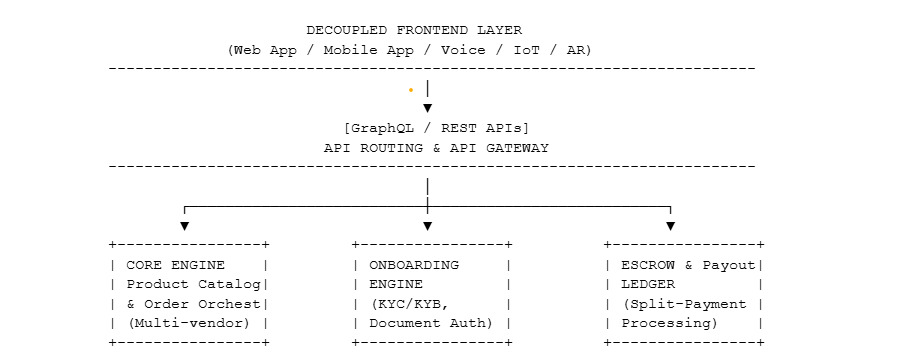
The primary advantage of composability lies in its natural flexibility. The marketplace is not a fixed website, but rather an ever-evolving mechanism that needs constant feature optimization. Whether you decide to implement a more advanced tax calculation matrix globally or replace the current artificial intelligence-powered personalization engine with a new one, all that becomes possible through the composable architecture without shutting down the entire checkout flow. Decoupled by default, such a solution prevents a marketplace from being vulnerable to single-point-of-failure risks. Thus, any unexpected spike in operations or glitch in the particular vendor’s custom integration of their inventory will never impact the entire purchasing process.
Secondly, going all-in on the API first approach results in an accelerated development cycle. Rather than putting a lot of developers towards the creation of the necessary database tables, identity access managers, and basic shopping cart functionality, you can direct your developer talent towards designing the proprietary drivers for your company. That includes coming up with your own match engine algorithms, localized searching engines, and community retention functions that will give your software its unique identity. By using modular back-end development frameworks, one can develop a high-quality enterprise ecosystem at a fraction of the cost compared to previous projects while still having all the creative freedom needed to be able to win the market or expand across different products.
Master Data Management and Unified Catalog Orchestration
Data governance is what truly sets up the foundation for building consumer trust in any shared digital marketplace space. If you allow hundreds or thousands of separate sellers to have the ability to upload their product listings at the same time, without any sort of oversight in place, then it is guaranteed that data corruption, data format anarchy, and language inconsistencies are going to be absolute givens. If one seller uses crimson to refer to a particular shade, another deep red, and yet a
nother the hexadecimal value of that same shade of color, then your search engine functionality and filters will absolutely fall apart. Unchecked, your store will quickly turn into a mess of low quality imagery, inconsistent categorization, dimensional mismatches, and so on.
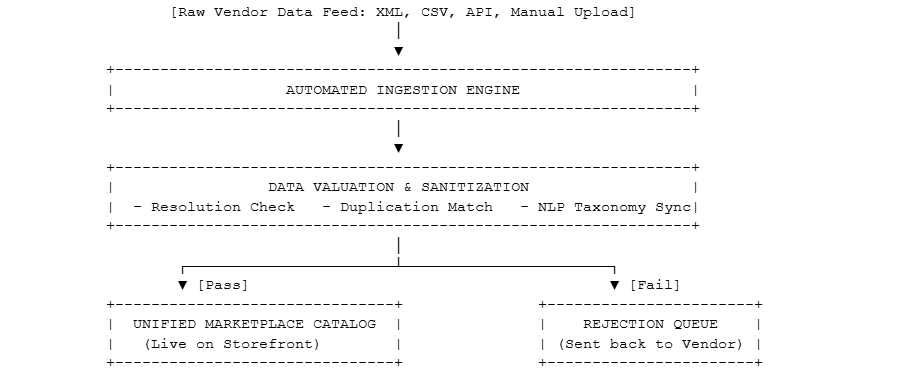
In order to solve this problem, the system needs to implement a strong Master Data Management architecture driven by automatic ingestion and cleansing capabilities. Once the seller submits a feed either manually or through bulk file upload or API stream, the data must be passed through the intermediate layer of validation prior to feeding into the live database. Validation process will ensure that the images of the products adhere to certain criteria like having adequate resolution and removing disallowed textures in the background. Moreover, NLP technology will be used in comparing title/descriptions with pre-determined taxonomies/category dictionary.
The problem of overlapping product listings is the biggest structural design challenge to address in the platform. For instance, in the event fifty different sellers post identical consumer electronics product on the platform, fifty duplicate product pages are created, which hurts your SEO ranking. The product-centric approach in terms of your architecture design should be used instead of vendor-centric one. In other words, your catalog database should contain a master product page, which will have a dynamic buy-box where the sellers who sell that particular product will be ranked according to customizable variables like price, proximity and speed of delivery.
The Complexities of Vendor Onboarding and Identity Governance
As far as initial merchant onboarding is concerned, this is the ultimate test of truth for any platform regarding its growth and retention strategy. If the platform adopts an attitude toward vendor management that is informal or manual in nature, it is setting itself up for great trouble in terms of friction, liability, and security risks. The modern-day onboarding process needs to be highly secure and automated, while at the same time being compliant with strict regulatory guidelines related to Global Know Your Customer and Know Your Business rules for thwarting money laundering and financial crime.
[Merchant Signs Up] ──► [Automatic ID / Tax Reg Check] ──► [Banking & Escrow Configuration] ──► [ERP/API Stock Sync] ──► [Launch!]
For effective optimization of this process, contemporary platforms will have their merchant funnel integrated into a dedicated merchant onboarding platform which enables automatic identity verification process. As soon as a merchant signs up, the system needs to automatically access international governmental databases and corporate databases to verify the corporation’s tax identification numbers, business registration, and beneficial ownership identities. On the other hand, banking systems need to be prepared to open up the deposits, connect the bank account, and configure all tax forms depending on the zones of activity of the seller.
In addition to being compliant, the technical onboarding process has to move quickly to get the merchant into an operational mode of productivity. This is done through providing dashboard tools that turn data engineering into very easy to do jobs. Merchants have to be allowed to immediately gain access to unified dashboard panels through which they can create automatic shipping profiles, build up multiple layers of warranty protection, assign personalized return locations, and allocate user permissions for various staff members. With such a refined onboarding process, the site gets rid of the previously steep initial learning curve and turns this former liability into a key competitive asset that wins the best merchants over.
Financial Architecture: Split Payments, Escrow, and Global Ledgering
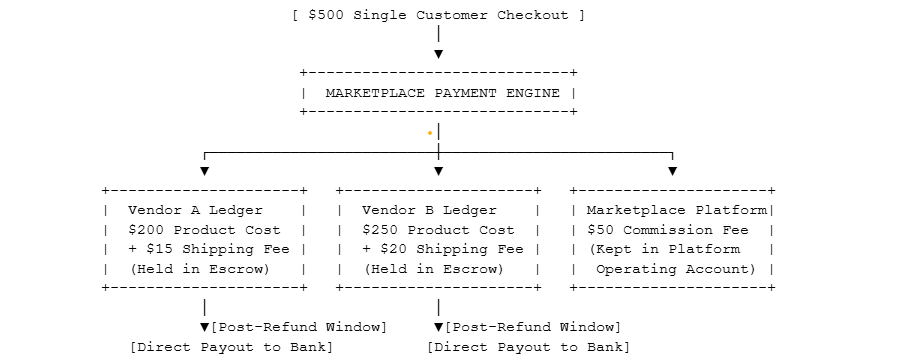
Of all of the technical obstacles faced while learning how to construct a multi vendor marketplace, building a system for financial ledgering and splitting out of funds is easily the most difficult task. An online shopper who uses your marketplace does not care what your corporate structure looks like. They want to have a seamless customer experience. The shopper is going to put a customized dining table supplied by Vendor A, a wool blanket offered by Vendor B, and a designer lamp from Vendor C all into their shopping basket, and expects to pay for everything at once using a single credit card transaction.
After a successful authorization from the payment processor, your marketplace platform needs to immediately begin performing a multi-level financial split. The total amount received needs to be allocated across a number of ledger entries. First, your platform needs to calculate your exact commission fee on the transaction. Secondly, you need to calculate the localized sales taxes, duties, and environmental charges for the transaction based upon the origin of the purchase and the location of the consumer. Finally, you need to make sure the remaining net amount is sent to the proper vendor-specific escrow accounts.
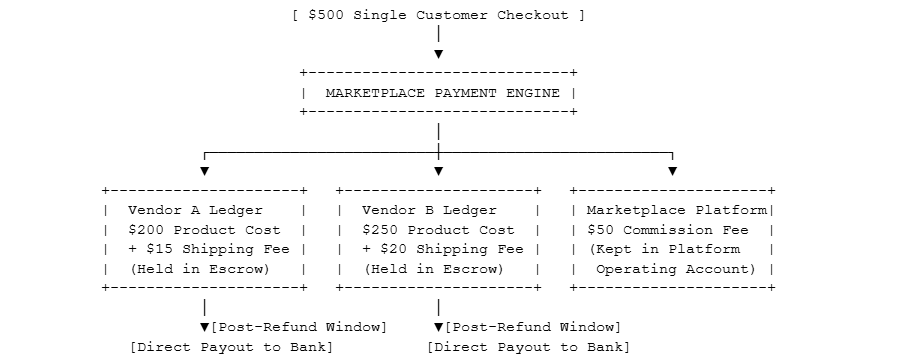
In light of this, it is evident that any market platform cannot be considered an intermediary transactional service for transferring money payments without fail. Since customers can legally ask for product returns, order cancellations, or fraud chargeback refunds due to any reasons, the marketplace itself must serve as an escrow entity that holds customer funds before paying merchants out. Customer money is to be stored inside special sub-merchant accounts or digital wallets until a specific cooling off period is reached (such as fourteen days after delivery) before automating backend operations to pay merchants out of their corporate bank accounts.
Moreover, international currency fluctuation management also introduces additional challenges in global platforms. In case a customer from Germany buys a product from a supplier in Japan using a platform run by an organization based in New York, the accounting mechanism should do real-time conversion of currencies and also account for changing foreign exchange rates while properly registering the hedging differences into the general ledger. Without properly considering these marginal cost factors in billions of transactions, the profit margin of the platform would get quickly eroded, thus making the availability of a good multi-currency reconciliation tool a must-have.
Logistics Orchestration, Multi-Warehouse Routing, and Fulfillment
The reputation of a brand of any marketplace is directly related to the efficiency of its fulfillment cycle. However, unlike an average e-commerce brand, which has complete control over its centralized distribution center, the fulfillment cycle of a marketplace is decentralized and largely unpredictable due to its dependency on a number of third-party vendors. Each vendor within the marketplace uses different capacities, regional logistics companies, packaging methods, and warehouses.
In order to preserve order within such a disorganized environment, the multi vendor e-commerce platform should play the role of a smart facilitator of shipping information. This can be accomplished through the creation of a distributed order management system which is capable of assessing the received orders and breaking them down into fulfillment packages. Once an order is placed, the system is supposed to assess the location of the buyer compared to the locations of the vendors’ fulfillment centers, compute the best shipping prices using multiple shipping carriers API, and produce separate packing slips and shipping labels.
Additionally, you need to take into account the multiple ways through which users may fulfill orders. Some online marketplaces use the dropship approach whereby an individual seller is in full charge of the physical shipment process and ensures they pick, pack and deliver the products to the consumer. High-end marketplaces use a more sophisticated method by creating their own fulfillment network where sellers can ship the product in large quantities to warehouses managed by the platform. It means the online marketplace can then consolidate several products ordered from different vendors and package everything in a single, eco-friendly parcel, reducing shipping fees while delivering a premium unboxing experience to customers.
Lastly, one of the main logistical challenges in a marketplace setting is the management of returns and return authorization. Returns are common in all eCommerce operations. However, in the case of a marketplace, any mistake during returns can create a huge problem both for consumers and the merchants. To solve this, you need a system with automation features such that when there is a return request, the returned goods will be routed directly back to the warehouse from which it was originally shipped while simultaneously generating the reverse payment split transactions.
Operational Scalability, Security, and Worldwide Compliance
As a digital marketplace transforms from a local network to a business-wide system handling millions of monthly transactions, major issues associated with scaling the infrastructure arise. The marketplace’s software platform faces significantly higher read/write load on the database compared to ordinary online stores. This is due to the fact that several thousand vendors are constantly contacting the database through the use of inventory synchronization applications, whereas millions of users from across the world send search queries and modify account status.
In order for the system to withstand these immense database loads, it is important for its database structure to utilize advanced techniques of optimization. These involve implementing microservices architecture, whereby different data modules like search indexes, user accounts, product catalogs, and ledger balances in transactions are completely separated into dedicated and independent database clusters that scale through cloud infrastructure. The use of heavy-read replicas, as well as very fast in-memory caching engines guarantees that products can be searched within seconds without any lock on the transactional databases where orders are processed.
In addition to this, it is imperative that the security protocols along with regulatory compliance be embedded deeply into each layer of your platform’s coding system. Considering the amount of sensitive financial documents, business documents, as well as personal consumer information that your platform will contain, it is only inevitable that your platform will be targeted by hackers and cyberattacks, thus, necessitating compliance with global security protocols like PCI-DSS Level 1 for payment management, and stringent data privacy laws across the regions like GDPR in Europe and CCPA in North America, which call for complete data protection and digital erasure of data upon user request.
Lastly, your operators need to develop comprehensive fraud detection mechanisms that will continually monitor the transactions taking place in the buyer-seller relationship. On the merchant’s end, you must have automated tracking mechanisms that keep an eye on the speed of the deliveries, their frequency, cancellation percentages, product ratings, and consumer disputes to identify any rogue actors or poor operators that might bring your marketplace’s reputation down. On the consumer’s end, machine-learning algorithms must scrutinize their shopping behaviors, geographical location, as well as the device signatures used.
Conclusion
Creating an advanced multi-vendor platform is one of the most rewarding and complicated tasks any business can tackle. It necessitates a perfect combination of versatile headless design, robust automated identity validation, dynamic master data directories, and automated split payment systems that will help navigate through all kinds of regulatory and operational roadblocks. Attempting to develop all those complicated components from scratch or piecing them together through third-party plugins is nothing but a surefire way of facing massive delays and escalating costs of development.
In order to successfully manage this challenging structure and increase your speed-to-market process, having a well-built infrastructure partner will be vital. This is precisely how the powerful ecosystem developed by Runtime Solutions has enabled the current generation of brands to transform and re-imagine their operational capability to take control over scaling. By offering a complete set of services such as web consulting, product engineering, and enterprise design, the full-service technology firm known as Runtime Solutions provides a single solution that is specifically designed to address the challenge of orchestrating a modern day marketplace.
Given that their technology stack offers native support for the open-commerce model, such as ONDC, as well as robust security features and automated payment routing, logistics tracking, and centralized control system, which function as premium vendor onboarding tools, all guesswork is stripped away in terms of architectural foundations. The use of their white-label, modular commerce architecture means that you will be able to shrink the development time frame from years to weeks and still retain the scalability that allows your business model to grow to infinite proportions in whichever industry it chooses to operate in. In order to discover how this can be accomplished with your business model, check out the possibilities of digital transformation offered by Runtime Solutions E-Commerce Platforms via the Runtime Solutions Main Portal.