
- Introduction
- What is a Contactless Attendance System?
- Why Demise of the Traditional Attendance Systems
- How do Contactless Attendance Systems Operate?
- Types of Contactless Attendance System
- RFID and NFC Systems
- Advantages of Contactless Attendance Systems
- Challenges in Using Contactless Attendance Systems
- Future Trends in Contactless Attendance Management
- Applications of Contactless Attendance Management in Real Life
- Technologies that Power Contactless Attendance Systems
- Impact on Psychology and Behavior of Contactless Attendance System
- Environmental Advantages of Contactless Attendance Tracking Systems
- Myths about Contactless Attendance Systems
- Conclusion
Introduction
Taking attendance used to be one of the simplest daily chores in schools, colleges, offices, and workplaces. A teacher would enter the class with a register in hand, call out the names one by one, and students would respond with a familiar Present, Ma’am or Yes, Sir. Likewise, employees would queue up in the office to clock in or place their finger on biometric scanners before commencing work.
For many years, these systems were considered perfectly normal. They were familiar, and they had been used for decades, so no one questioned them. But when the world began changing quickly with technology, it took a while for people to understand that you could improve small, everyday tasks.
Everything around us is getting smarter and automated these days. We text each other instantly on our smartphones, store data on cloud platforms, meet virtually, and run businesses digitally. And of course, the organizations also started to expect their attendance systems to be faster, safer, and more efficient.
Then one of the biggest turning points in recent history happened – the global pandemic.
People have suddenly become more conscious of hygiene, physical interaction, and shared surfaces. Fingerprint scanners that once seemed cutting-edge started to feel risky, as hundreds, if not thousands, of people touched the same machine every day. The problem was long lines at office entrances and overcrowded attendance areas.
Here is where contactless attendance systems started to play a massive role.
What had seemed to be an optional technological upgrade soon became a practical necessity.
Today, contactless attendance systems are used in Schools and colleges, corporate offices, hospitals, airports, industrial manufacturing units, stores, government institutions, and remoteworking environments, etc.
But such systems are more about eschewing physical contact. They are a much bigger step towards smarter workplaces, higher efficiency, improved accuracy, improved hygiene, quicker operations, and reduced administrative burden
In this comprehensive guide, we will explore what contactless attendance systems are, how they work, the types, technologies behind them, benefits, challenges, applications, and future potential.
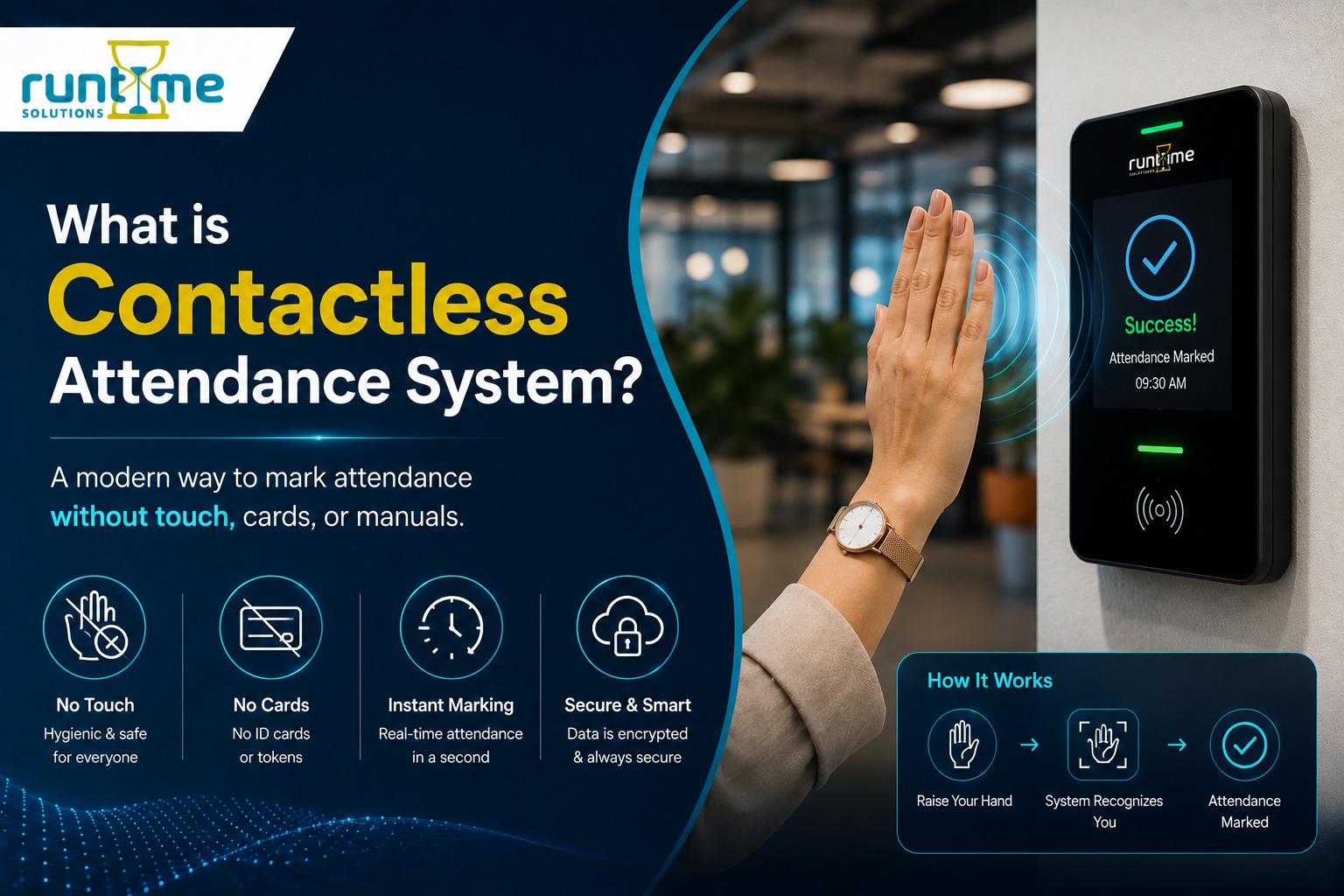
What is a Contactless Attendance System?
A contactless attendance system is one where you can take attendance without touching a device. Unlike traditional attendance systems, where people have to register by signing, fingerprint scanners with touch, or swipe cards, attendance can be marked automatically or remotely through contactless press buttons.
The whole idea of contactless attendance is to make the whole process smooth, fast, hygienic, and easy. In many modern systems, people are not even aware that their attendance is being recorded because it happens silently in the background.
For instance, an employee enters an office building, and their attendance is automatically logged via facial recognition, or student enters a classroom, and the system automatically updates attendance, or the remote employee signs in using a mobile app with GPS verification and marks attendance automatically.The main difference between conventional systems and contactless systems is that contactless systems work on presence without physical action.This little tweak leads to a huge gain in efficiency and user experience.
Why Demise of the Traditional Attendance Systems
Let’s first understand why contactless attendance systems are gaining so much importance. To understand that, we need to understand the limitations of traditional attendance methods.
Manual systems stuck around for many years because they were familiar and easy to understand. But as organizations got larger and more digital, the flaws in these systems became more obvious.
1. Manual Attendance Takes a Lot of Time
At first glance, attendance may appear to be a minor task. But if you look closer, the amount of time gets surprisingly large, especially in large schools or offices.
Imagine a school with the attendance taking takes 5-10 minutes, or several classes per day, or involves hundreds or thousands of students. These few minutes eventually add up to hours spent during the school year in wasted teaching time.
This is also seen in office setups. They usually involve standing in lines to use biometric machines, waiting until others finish, or being slowed down when entering during high traffic periods.
This will affect work efficiency. Despite the fact that attendance isn’t really a big job, it disrupts the workflow.
Contactless systems help solve this problem since checking in attendance becomes instantaneous.
2. Issues of Hygiene and Safety
Probably the biggest reason why there was a shift towards contactless attendance systems was that of hygiene. Systems such as fingerprinting and those involving physical attendance devices would mean hundreds of individuals have touched the same thing every day. After the pandemic, businesses have become much more wary of things like disease spread, physical contact, workplace safety and public hygiene, and this led to the need for a system that did not involve physical touch.
3. Human Error in Manual System
Manual attendance systems depend on human labor and focus. There exists room for human error, including accidental omission of names, Error in information, Duplicate entry, or Inaccurate record of attendance. Human error will always exist, even in cases of cautious administrators, when dealing with large attendance data. Long-term effects of the above will be error in payroll calculation, error in academic information, error in employee management, and wrror in attendance report. Use of automated contactless systems eliminates such errors to a great extent.
4. Proxy Attendance and Manipulation
One of the most common issues in manual attendance systems has been proxy attendance.
These include attendance of students on behalf of their mates or punching attendance of other people in the attendance card, or the use of one access card by multiple employees. Manipulated information will make the process inaccurate. In the case of a facial recognition system, there is very little chance of any proxy attendance.
5. Higher Administrative Burden
Attendance tracking is not limited to identifying who attends. For organizations, it requires some actions to be performed, that are record keeping, report creation, payroll processing, attendance trend analysis, and communication with parents or superiors. Most traditional systems involve the need for manual data entry and repetitive paperwork. It increases the burden on Human Resource personnel, school administrators, managers, and lecturers. In contrast, contactless systems eliminate this burden.
How do Contactless Attendance Systems Operate?
Despite the difference in technologies used in contactless systems, most operate using a similar process flow. Let us analyze this flow in detail:
Step 1: User Registration
The first step involves user registration. At this stage, data pertaining to the user is entered into the system. Based on the technology used, the registration may involve collecting facial data, registration of mobile devices, employee ID linkage, essignment of RFID card, and GPS authorization. The system generates a digital identity for each user, as such an identity will become the benchmark for verifying attendance in the future. User registration is the most crucial phase since it is at this point that accuracy is achieved.
Step 2: Detection of Presence
Upon activation, the system automatically begins detecting users. Detection could be made through AI Cameras, Mobile Applications, GPS Systems, QR Code Scanners, and RFID Sensors. Examples are the camera detects a person’s face the app detects location or the sensor detects an RFID Card. The aim is to detect the presence without any manual effort.
Step 3: Verification
Once the presence of the person has been established, the next step is verification. Depending on the technology used, verification works differently as the facial recognition system analyses facial pattern matches, the GPS system verifies location coordinates, the QR system scans for code matches, and the RFID verifies the card matches. The verification process becomes successful once there is a match of information.
Step 4: Recording Attendance
After successful identification and verification, attendance is recorded. In doing so, the system records data digitally, then updates reports immediately and notifies where applicable, and creates real-time records. This process does not take more than a few seconds.
Types of Contactless Attendance System
There are various types of contactless attendance systems based on the organization’s needs.
1. Facial Recognition Attendance System
Facial recognition is one of the advanced methods of recording attendance in organizations. It involves the use of AI cameras, machine learning algorithms, and facial recognition software. Among the main factors that the system considers in analyzing faces are eye distance, jawline shape, facial structure, contour, and patterns. Once the individual comes into the building, facial recognition technology is compared against the existing database. If there is a match, then attendance will be recorded automatically.
Facial Recognition Systems advantages are that they are totally touchless, exceptionally speedy, remarkably accurate, no proxy attendance is possible, and queue minimization.
It is widely utilized in chools, colleges, business organizations, airports, hospitals, and Government institutions.
2. QR Code Attendance Systems
The usage of QR code-based attendance systems rose dramatically throughout the pandemic because of their simplicity and cost-effectiveness. In this technology, the QR code is shown at the entrance, as the user scans the QR code through their smartphone, and the attendance is updated instantly.
The benefits of this are that it is easy to adopt, inexpensive, minimal physical contact, and convenient for educational institutions and event venues. Nonetheless, these systems need manual intervention from the user’s end.
3. GPS-Based Attendance Systems
GPS-based attendance systems find utility for remotely or field-based employees. This technology relies on the user’s current position to record attendance, for example, the salesperson reaches a client’s site. He opens the attendance app, and the GPS detects the exact position, and the attendance is marked automatically.
Advantages are they are absolutely perfect for a remote workforce, especially beneficial for field activities, ensure accountability, and are perfect for hybrid workplaces.
RFID and NFC Systems
RFID (Radio Frequency Identification) and NFC (Near Field Communication) systems operate on wireless communication technology. The users use RFID cards, smart tags, and NFC devices. Once they approach the entrance point, their presence is detected by the sensor that logs attendance.
Advantages are quicker compared to swiping, very little contact required, and useful in congested locations.
Advantages of Contactless Attendance Systems
Contactless attendance systems have numerous advantages for both companies and staff members.
1. More Efficient Attendance
Speed is probably one of the greatest benefits. With contactless systems, there is no need to queue up or touch any device or sign attendance sheets by hand. The attendance process becomes quicker and easier. Thus, workflow and class management improve significantly.
2.Enhanced Hygiene
Physical interaction is minimal, which contributes to creating a safer environment, better hygiene conditions, and decreased risks of infections. These benefits are essential for hospitals, schools, and public offices.
3. Increased Accuracy
Human errors are eliminated by automation, which means that attendance is more accurate, easier to manage, and more reliable.
4. Real-Time Data Collection
Administrators can immediately see the list of those present, who missed work, latecomers’ information, and trends regarding the overall attendance rates.
5. Reduced Administrative Tasks
Paper-based attendance systems usually involve repetitive tasks. However, with contactless systems, there is no need for handling record files or preparing reports manually or saving data manually, or summarizing attendance records.
6. Improved Data Management
Contactless attendance systems provide easy and secure data storage. They make it possible to analyze attendance patterns, prepare reports in seconds, and keep track of records for years.
Challenges in Using Contactless Attendance Systems
Although contactless attendance systems have numerous advantages, they also pose several problems.
1. Privacy Issues
Personal data safety is one of the most notable issues. People may fear that their data is saved securely, can be accessed by third parties, or can be used illegally. Organizations should ensure that the information is encrypted, servers are safe, access is limited appropriately, and adequate consent is obtained.
2. Higher Costs during Implementation
More advanced contactless attendance systems may need to install cameras, set up sensors, program software, and make digital infrastructure adjustments. These processes can be costly at the start. Nevertheless, most organizations find the expenses worthwhile due to subsequent productivity gains.
3. Technological Problems
Like other technologies, contactless systems might encounter connectivity problems, camera malfunctions, computational errors, or lagging recognition. Regular system maintenance is critical.
4. Resistance to Innovation
Human beings do not like change. Sometimes, employees or learners may prefer traditional methods, be intimidated by technology, or have privacy concerns. Training and communication mitigate resistance.
Future Trends in Contactless Attendance Management
In the coming years, attendance management will become smarter and more intelligent than ever before. Some of the possible features of future contactless systems will be integration of AI analytics, smart building systems, employee management systems, and behavior tracking systems. Future contactless systems will make it possible for businesses to know about the trends in their production, trends of movement, engagement of students, and efficiency of employees. The purpose of the attendance management system is to change into organizational intelligence.
Applications of Contactless Attendance Management in Real Life
Contactless attendance is not confined to office spaces or classrooms anymore. The truth is that today, various industries are using contactless attendance systems. This is because all organizations seek efficiency, security, and accurate attendance tracking.
Contactless Attendance in Educational Institutions
Institutes of learning are some of the biggest users of contactless attendance management systems. Traditionally, teachers devote precious time to manually taking attendance at the start of every class. This might appear insignificant, but that is not true since the amount of time lost in each lesson can add up to form a considerable amount of time in a year. Contactless attendance systems allow schools to utilize their class time effectively, ensure discipline amongst learners, prevent attendance fraud, reduce paperwork, and monitor accurate attendance figures. These tools become highly relevant in the educational sector as they recognize the presence of individuals in an automated manner without demanding any response from them. For instance, when a student comes into class, the tool identifies the individual by scanning their face within the classroom and updating the attendance details. This means that the teacher will start the class without any delay. Moreover, it makes classroom management easier and enables teachers to concentrate more on teaching rather than handling administrative tasks. Parents also receive immediate alerts if a child is absent from school.
Contactless Attendance in Corporate Offices
Modern organizations have become more digital and centered around their employees. Modern-day organizations need systems that would enhance both organizational performance and the experience of the employees. Queue formation at biometric machines may cause some delays as employees will join the queue to gain access to the organization simultaneously, mostly in the morning. Such situations have been resolved using contactless systems whereby the employee can directly enter the organization, and attendance is captured automatically. It brings about fast entry into the office, improved workflow management, and a reduction in congestion. Attendance records are used by corporate organizations for payroll processing and shift management, among other things.
Contactless Attendance in Hospitals
High levels of cleanliness are essential in hospitals. It is very significant in the healthcare sector for there to be a reduction of physical contact as hospitals will deal with patients, staff members, sensitive areas, and even infections. Scanning devices using fingerprints and shared devices do not meet the requirements of hospitals. The use of contactless systems enables hospitals to monitor attendance without any risks and even makes scheduling much easier.
Contactless Attendance in Manufacturing Industries
The manpower employed in factories and other manufacturing plants tends to be quite large. The traditional system of taking attendance at these places can cause a number of issues, including long lines when changing shifts, late production schedules, crowds at the gates, and manipulating attendance figures. The contactless system of taking attendance enables smooth workforce management since individuals can access the premises without delay, with attendance being automatically noted.
Contactless Attendance for Remote and Hybrid Working Models
In today’s workplace, one of the major changes that has occurred is the introduction of remote and hybrid working models. Companies have to deal with a workforce that works from home, travels extensively, works from several locations, and meets their clients personally. In such scenarios, conventional attendance methods are ineffective. It is here that the use of GPS and application-based attendance systems proves to be very helpful. Workers can register their attendance via applications on their smartphones, confirm their geographical position by using GPS, and report work progress from afar.
Technologies that Power Contactless Attendance Systems
While contactless attendance systems might seem straightforward from the perspective of users, such systems depend on various complex technologies being applied simultaneously.
Learning about these technologies sheds light on why such systems have become increasingly dependable and smart.
Artificial Intelligence (AI)
Artificial Intelligence plays a very significant role in contemporary attendance management systems by enabling the systems to analyze patterns, be accurate, learn from data, and make intelligent decisions automatically. For instance, facial recognition technology uses artificial intelligence to detect facial features despite differences in lighting conditions, glasses, facial expressions, and hairstyles.
Machine Learning (ML)
Machine learning is a subfield of artificial intelligence in which the ability of computers to learn from experience and make predictions is enhanced. The more data the machines handle, the better they get at identifying users, minimizing mistakes, and detecting patterns.
Cloud Computing
Cloud computing describes the use of cloud platforms in storing data. The benefit of using cloud computing is that data can be accessed anywhere as long as there is an internet connection. Additionally, it enables large amounts of data to be stored securely, generates reports in real-time, and synchronizes attendance management across various places.
Internet of Things (IoT)
IoT describes a network of smart devices that use the internet to communicate with each other. Some of the IoT devices used in attendance management systems include smart sensors, cameras, and radio-frequency.
Impact on Psychology and Behavior of Contactless Attendance System
Strangely enough, a contactless attendance system has psychological effects as well. Knowing that attendance tracking will be fully automated, objective, and tamper-proof, this automatically leads to better punctuality, higher accountability, and enhanced discipline. The students would find it difficult to miss lectures due to the reliable nature of tracking attendance, and employees would try to maintain their punctuality at the workplace.
Environmental Advantages of Contactless Attendance Tracking Systems
In addition, one cannot ignore the environmental benefits of a digital attendance tracking system. The traditional method of tracking attendance involves the use of paper sheets and registers. The amount of paper waste created through this process is massive. In contrast, a digital attendance tracking system helps in saving paper and reduces the need for printing. Thus, it promotes environmentally friendly policies.
Myths about Contactless Attendance Systems
There are many myths regarding the working of contactless attendance systems that persist despite being debunked by reality.Some of the popular myths include the following.
These Are Only Applicable for Large Corporations
This myth is now outdated. Many cost-effective solutions exist for attendance tracking in small firms, coaching centers, startups, and schools as well.
Facial Recognition Is Not Secure
The systems use encryption and safe methods for storing the information collected.
The systems typically do not save the pictures themselves, but turn the facial data into encrypted patterns.If the system is used correctly, it becomes extremely secure.
Technology Will Take Our Jobs
Contactless systems have been invented not to replace people but to support the organization. They are meant to make the repetitive tasks simpler, increase efficiency, and make record keeping easier. Thus, it will allow the teachers, managers, and HR departments to devote their efforts to something more significant.
Conclusion
Contactless attendance systems are not just technological innovations. The implementation of such innovations means a bigger step towards making our environments smarter, more efficient, and safer. By eliminating the need for any kind of physical touch, the systems simplify the routine task. In this way, the organizations get better productivity and efficiency while managing their records. On the personal level, these technologies make the processes faster and safer without interrupting other activities. The most important thing about contactless systems is that they improve the lives of everyone quietly. Technology should not