
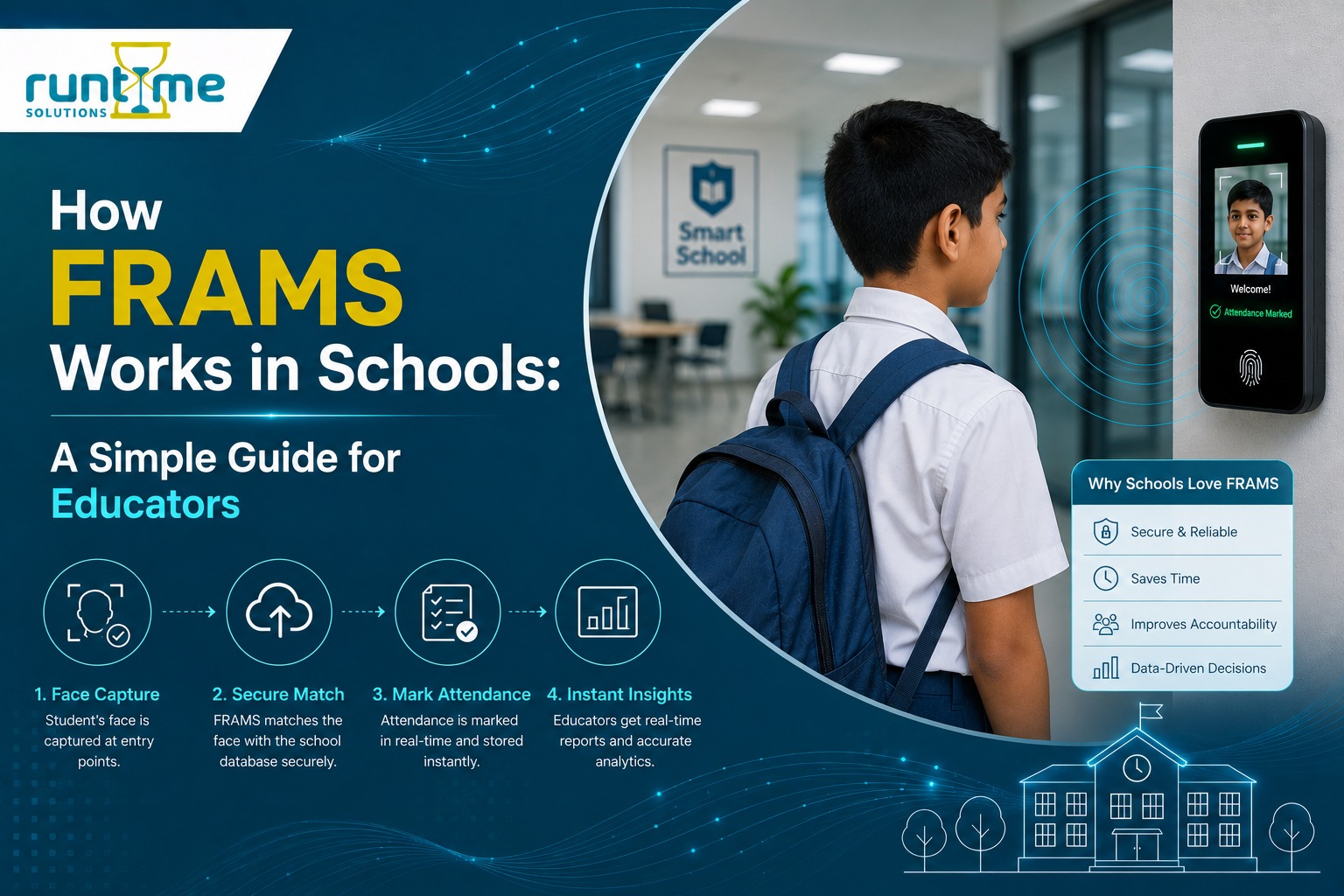
- What is FRAMS? Getting to Know FRAMS in Action
- Why Old School Attendance Methods Don’t Work in Today’s Classrooms
- Behind the Scenes of FRAMS: Four Key Steps in Action
- A Day in the Life of the FRAMS System
- The Far-reaching Advantages of Moving to FRAMS
- Addressing the Elephant in the Room: Privacy and Ethical Issues
- Problems to Take into Account during Implementation
- The Future: What Lies Ahead?
- Concluding Remarks: Reclaiming the Human Factor
There was a time when attendance in schools was one of the simplest and most routine parts of the day. A teacher would come into the classroom, open a thick leather-bound register, and call out names one by one. Students would chime in with a well-learned, “Present ma’am,” or “Yes, sir,” the teacher would obediently write down a ‘P’ or an ‘A,’ and in ten minutes the class would be on to the real lesson.
It was a process so familiar that nobody really stopped to ask any questions. It was the pulse of the morning, a ritual passed down through generations of educators.
But look at it from today’s perspective, especially in a world where technology is changing almost every aspect of our lives, and this same process starts to feel a bit old-fashioned. Not that it is completely useless, but because it has not kept up with the pace of the students we teach, or the world they are graduating into.
Expectations have changed in today’s schools. Teachers are no longer just providers of information. They are supposed to be mentors, facilitators, and high-energy classroom leaders. Administrative systems are becoming more data-driven and require real-time accuracy. In this high-stakes environment, even small inefficiencies, like the ‘quiet theft’ of time taken up by manual attendance, start to matter a lot.
Here is where FRAMS, or Facial Recognition Attendance Management System, comes into the picture.FRAMS is not simply the paper attendance register replaced by a digital one. It signifies a profound change for smarter, more empathetic systems that lessen human effort, enhance accuracy, and most importantly, give teachers back their true purpose of teaching.
In this comprehensive guide, we will have a simple, clear, and deeply human look at how FRAMS works in schools. This guide is for you, whether you’re a tech-savvy admin or a teacher who prefers a chalkboard over a tablet.
What is FRAMS? Getting to Know FRAMS in Action
At the most basic level, FRAMS is a facial recognition-based system that automatically identifies and registers the presence of students. But to see what it’s actually useful for, it helps to ditch the jargon and think about how we humans recognize people.
The Bond of Humanity
Say you’ve been teaching a class for a few weeks. After a while, you’ll know your students right away. You don’t have to read a name tag or look at a seating chart; you just know them the minute they walk through the door. You know how the student’s eyes crinkle when they laugh, or the shape of their particular face.
FRAMS is remarkably similar in how it works, but it is digital patterns, not human memory.
Once a student is registered in the system, their facial features are recorded and converted into a unique digital ‘map’. Later, when the system ‘sees’ that face again through a camera lens, it compares that live image with its stored library and verifies the identity almost instantly.
From Doing to Being .
The biggest thing about this system is that you don’t have to do anything as a student or teacher. Attendance is an action in a traditional setting, something you have to do. You have to call the student’s name; the student has to answer.
With FRAMS, attendance is an existence. Just being in the room is enough for the record to be made. This small change removes the friction of administrative ‘checkpoints’ and allows the school day to flow naturally.
Why Old School Attendance Methods Don’t Work in Today’s Classrooms
To appreciate the school’s adoption of FRAMS, we need to take a hard look at the hidden costs of the old ways. We often ignore these because ‘that’s the way it’s always been’, but the cracks are beginning to show.
1. The Silent Theft of Teaching Time
At first glance, calling names looks like a 5-minute job. But let’s do the math from an educational perspective.
A teacher taking 5 to 7 minutes for roll call for each class and managing five classes daily wastes about 30 minutes of instruction time daily. This amounts to a staggering number of more than 90 hours wasted throughout the year.
Time that would otherwise be spent on:
• Delivering in-depth explanations of difficult science, technology, engineering, and mathematics concepts.
• Checking in individually with a troubled pupil regarding their mental state.
• Conducting a debate to encourage critical thinking.
• Simply beginning a lesson when students’ minds are sharp.
2. Human Error is Unavoidable
In any case, teachers are humans, and multi-tasking is the norm. While maintaining discipline among rowdy students, addressing questions from tardy students, and recording the names on the attendance list, it can become extremely difficult to:
• Carelessly miss someone in an extensive list.
• Mistakenly put down a student as ‘present’ who has left the class a minute earlier.
• Incorrectly misread an entire row and recorded someone as ‘absent’.
All these mistakes lead to a situation of what is known as ‘dirty data’. When the administration uses this data for analyzing attendance trends at a later stage, it becomes highly inaccurate and unreliable. U
3. The Proxy Problem and Lack of Accountability
We have all witnessed such instances before when a child shouts, “Here!” on behalf of his or her buddy. While children may not consider this to be an issue, it poses a major security and liability concern for the institution. If a child is registered as present while he or she is off-campus premises and gets into an accident, the institution will be faced with a difficult legal situation.
The use of FRAMS would completely eliminate the possibility of proxy attendance since it is impossible to impersonate a face.
4. Post-Implementation Administrative Workload
In many institutions, manual registration is just the start. The collected information must be entered into the School Management System (SMS) using an office worker as the intermediary.
Behind the Scenes of FRAMS: Four Key Steps in Action
Artificial Intelligence can be daunting to some educators. But let us delve into the intricacies of how this system functions and find out the four main stages involved in its operation.
Phase One: Enrollment (Creating the Library)
The first phase occurs at the beginning of the year. In the enrollment stage, a good baseline picture is taken of all students.
However, the key thing to remember about this system is that it is not saving the picture. What it is actually doing is conducting an analysis, taking into account such metrics as:
• Eye distance
• Nasal width
• Depths of eye sockets
• Bone structures of the cheek and jaw line
All these elements are translated into numerical strings, a facial template. This template is stored, rather than the picture itself. This difference makes it impossible for anybody trying to steal the information from the database to get anything but a bunch of numbers, rather than a picture collection.
Phase Two: Detection (Finding a Human)
After installing the cameras (normally at the school entrance and at classroom doors), the system enters the ‘detection’ phase.
The program is configured to identify the basic geometric shape of the human face. It does not consider the backpack, the wall behind the student, and the dog that suddenly runs across the playground. The algorithm concentrates only on the face’s oval structure. Contemporary FRAMS technologies are advanced enough to recognize several faces simultaneously, even when students move in groups or interact with each other.
Phase Three: Analysis and Comparison (The Matching Game)
This is how the magic works. The program matches the face just detected by the device to the templates stored in its database
Another interesting question posed by educators is: What if the student decides to grow a beard, change their hairstyle, or put on glasses?
Advanced facial recognition algorithms do not depend on surface parameters such as hairstyle, facial makeup, or facial hair. They analyze the unique bone structure and nodal points of the face, which remain almost unchanged with any haircut or eyewear. That is why the technology is exceptionally efficient during the student’s growth period.
Phase Four: Instant Logging (The Action)
• Leo Smith | Grade 10 | Present | 8:02 AM.
No paper, no pens, and no manual logging are used. The information is born digitally.
A Day in the Life of the FRAMS System
To gain insight into its effect on daily activities, we need to go through a typical day at school when the system is running in full swing.
8:00 AM – The Arrival
At a conventional educational establishment, entering the institution is always the busiest time for students, which involves waiting in queues, scanning their ID cards, or signing the sheet. In FRAMS, however, there is no need for any such procedure, as it is enough to calmly enter the building via the main entrance gate. This could happen in the course of having a conversation, drinking from a juice box, or playing on their phone. The overhead cameras check the students in.
8:15 AM – From the Teacher’s Point of View
Mr. Henderson enters the classroom for the 9th-grade History lesson. Rather than reaching for the register, he glances at his tablet or the interactive board. It will show a green dashboard with all the necessary information, indicating that 28 out of 30 students are present.
Rather than allocating 10 minutes to roll call, he begins the class with an exciting introduction on the French Revolution.
10:30 AM – The Safety Check
Throughout the day, one student attempts to leave campus before time without any permission from the school authorities. While passing by the security camera, the system identifies him and notices that he doesn’t have any ‘Early Departure’ approval status on his account. An automatic alert is generated in the security room.
4:00 PM – The Parents’ Involvement
At his house, the parent receives a timely message through the app provided by the school: Your kid, Leo Smith, arrived at school at 8:02 AM today and left at 3:45 PM. It builds trust between the home and school, giving parents peace of mind despite their busy schedules.
The Far-reaching Advantages of Moving to FRAMS
Apart from merely saving time, FRAMS brings an array of advantages for everyone involved in the education process.
1. Increased Safety of Students
As students’ safety becomes a critical aspect, knowledge of all the people present at a particular moment on the school premises becomes necessary. An administrator will be able to download a list of all the present individuals with just one click in case of any emergencies.
2. Accuracy of Data for Prompt Actions
Chronic absence plays an important role in determining whether the student is successful or not. In case the data is collected manually, it will take several weeks for the trends to become apparent. However, the FRAMS system will automatically signal if the student arrives late for three consecutive times or skips up to 10 percent of classes. As a result, there is ample opportunity to make changes that prevent the slip from becoming a fall.
3. Cost – effectiveness
There is an initial cost associated with installing cameras and software. However, taking into account the amount of administrative time that could be saved, the return on investment is considerable.
4. Removal of Unconscious Biases
Although well-meaning, human teachers cannot avoid being subject to biases themselves. Some teachers may tend to be lenient towards one pupil because he likes him, whereas strict to another pupil whom he dislikes when they come late to class. FRAMS treats each student equally because it registers the arrival of students objectively and with mathematical exactness.
Addressing the Elephant in the Room: Privacy and Ethical Issues
Of course, it is natural to be wary of ‘big brother’ technology as a teacher. Schools need to be a place of safety and nurturance rather than of surveillance and fear. With any new technologies, three ethical concerns need to be addressed when installing and using FRAMS:
Informed Consent
It must be made clear to both parents and pupils what the technology is about and, more importantly, what it is not about. This technology is a means of “identification,” not of “surveillance.”
Data Security
The collected information must be stored in encrypted form on secure private servers, not on public ones. The collected data should not be handed over to private marketing or governmental law enforcement companies.
The “Human in the Loop”
FRAMS should never substitute human judgement. Even if the FRAMS algorithm indicates an absence of a particular student, but the teacher can observe that he or she sits in the last row of the classroom, then the latter will be considered correct.
Problems to Take into Account during Implementation
Not all technologies act like a “magic wand.” There are numerous obstacles that the school has to overcome before the implementation of the FRAMS technology:
• The Initial Cost: The acquisition of high-quality cameras and a special algorithm may cost money. Nevertheless, the majority of schools note that the technology pays off in terms of time saved in one or two years.
• The Infrastructure: The institution should have stable, high-speed Internet and electricity connections. It may require a slight technological face-lift for an old-school building.
• The Learning Period: Despite being an automated process, it still requires training from the teaching staff in accessing statistics and managing enrollment of new students.
The Future: What Lies Ahead?
Face recognition is merely an entrance. After a school has established an efficient digital identification system, there are endless possibilities for what lies ahead:
• Automated Book Loaning: A student would be able to borrow books without even touching a machine by simply carrying a book near a sensor.
• No Need for Cash: With no need to carry any cash and having to remember complex PIN numbers, a student’s face will become his/her purse, with the balance replenished by parents.
• Prediction of Behavior: In the future, facial recognition could predict behavior trends in a classroom environment, allowing teachers to adapt to the situation on the spot.
Concluding Remarks: Reclaiming the Human Factor
Ultimately, the aim of any form of educational technology, a computer, a smart board, or even a system of facial recognition, must be to create a more human experience for its users.
This may seem like a paradoxical concept, since after all, a ‘machine’ is not inherently human in nature. However, by relieving teachers of the burdensome, mechanical duties that take away from their natural human capacity to inspire and motivate, one effectively provides an instructor with the necessary resources to reconnect to their true calling.
The value of FRAMS is neither its camera nor its algorithm. The value lies in the five minutes it allows back into a teacher’s schedule each hour; it lies in the relief and peace of mind it provides parents at the end of a day. FRAMS creates a human environment of recognition and safety, in which children’s faces are identified as quickly as their names are.
The next step for our future-oriented, technology-savvy educational institutions is to utilize technology to free up time for something much more meaningful than anything technological – the connection between a teacher and a student.
Runtime FRAMS Attendance Solution is at the vanguard of this trend. As a state-of-the-art recognition engine designed for optimal facility management, Runtime is capable of using any current CCTV system on campus. This product includes:
- Walk-Through Attendance: Students do not need to wait in line or pause; a deep learning algorithm captures many faces in motion at normal walking pace.
- Anti-Spoofing Technology: This product prevents proxy attendance through photos or digital screens.
- Real-Time Dashboards: Administrators and teachers receive live push notification, shifts/classes tracking, and automated reporting either online or via app.
It is not only about complex algorithms, which are great to have, but also the five extra minutes the teachers would receive every hour. With such solutions in place, technologies are working in silence in the background and allowing for the best feature of schooling to shine: the relationship between teachers and students.