
- Introduction
- What Is a Biometric Attendance System?
- How Does a Biometric Attendance System Work in Schools?
- Types of Biometric Attendance Systems Used in Schools
- Key Benefits of Biometric Attendance Systems in Schools
- Privacy, Ethics, and Child Safety Considerations
- How to Implement a Biometric Attendance System in Your School: A Step-by-Step Guide
- The Future of Biometric Attendance in Schools
- Conclusion
Introduction
Handling school attendance is among the most time-consuming and prone to mistakes activities that teachers are tasked with undertaking daily. With a number of thousands of pupils in a single school and each one learning in multiple classrooms, it is estimated that the amount of work needed just to mark attendance in registers, note absenteeism, and communicate with parents takes up much more valuable time. According to a survey done by the Central Square Foundation in 2022, teachers in India devote on average 15-20 minutes of their workdays to non-teaching administrative tasks, with handling student attendance being one of the most common. The number of non-teaching minutes spent by teachers equates to about 55 hours lost during the period of 220 workdays.
The use of biometric attendance systems is a great way of solving this age-old problem. These systems employ the use of unique biological features of a pupil or employee, including fingerprints, face structure, or iris pattern, to automatically determine their identity. Such an approach eliminates the chances of making any mistake and proxy attendance.
What Is a Biometric Attendance System?
A Biometric attendance system is a technology platform that automatically captures the presence of an individual at a specific time and location using his or her unique biological or physiological characteristics. Biometric systems verify identity based on something a person is, not something a person knows (like a pin) or something a person has (like an ID card). This is a trait that cannot be lost, forgotten, lent to another person, or easily forged, unlike traditional attendance methods.
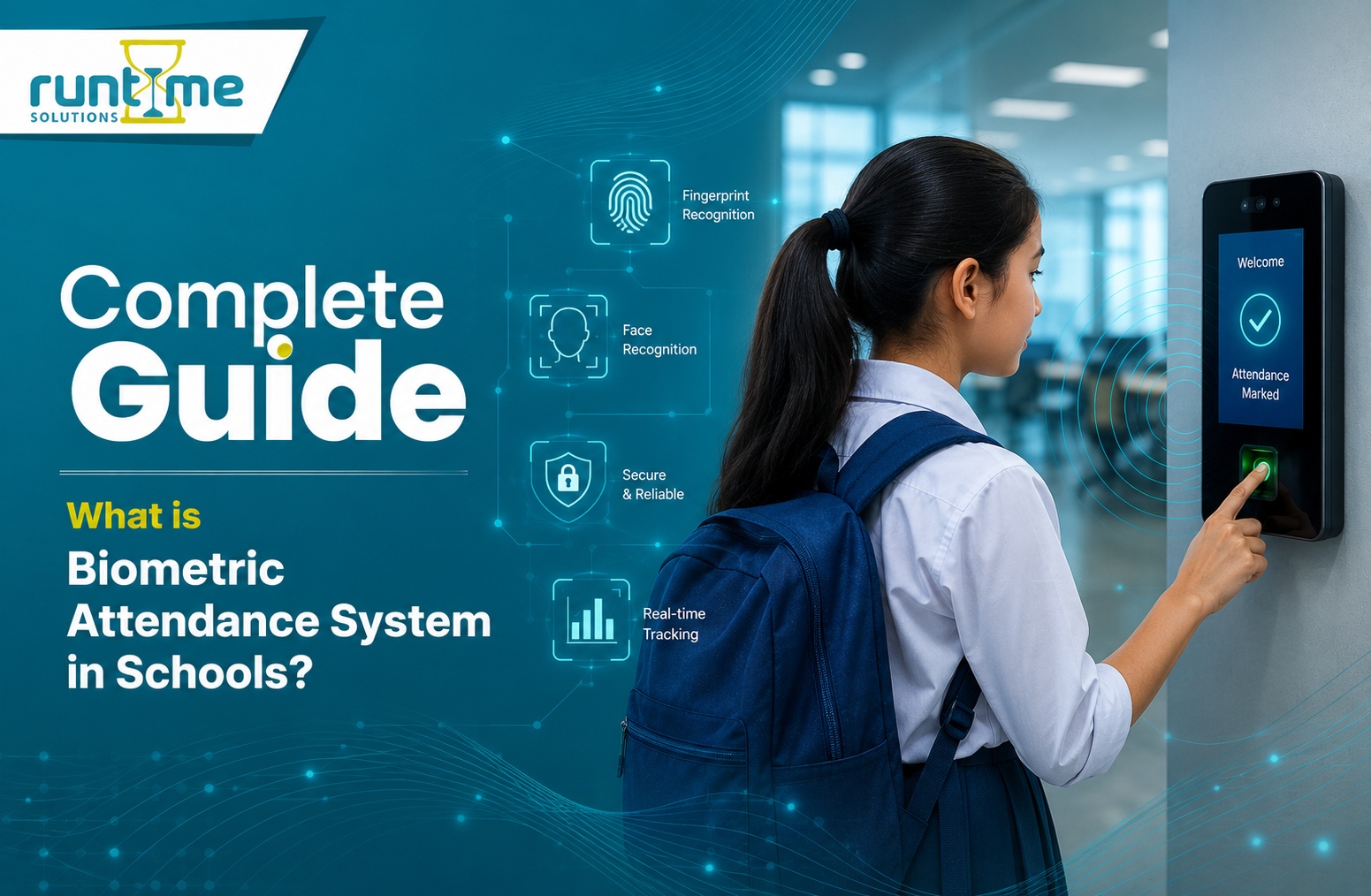
In schools, biometric attendance systems are commonly positioned at the school entrance, classroom doors, or staff check-in stations. When the student or staff member comes, he or she interacts with the biometric device (for example, the device may require the student or staff member to put his or her finger on a scanner, look into a camera, or stand in front of a sensor), and the system immediately matches the biometric information with a pre-enrolled database. If the match is successful, the attendance record is automatically created, time-stamped to the second, and stored digitally. The whole process takes less than 2 seconds and doesn’t require human intervention.
The data from the biometric device is fed into a central attendance management software that can generate reports, trigger parent notifications, flag anomalies, and integrate with the school’s wider administrative systems, including student information systems, fee management software, and government reporting portals. Modern systems also offer cloud-based deployment.
How Does a Biometric Attendance System Work in Schools?
Understanding how these systems work is important for school leaders making procurement decisions, for parents who want assurance about how their children’s data is handled, and for teachers who will interact with the system daily. The process can be understood in three distinct phases: enrolment, recognition, and reporting.
Phase 1: Enrolment
A biometric attendance system has to know who the person is before it can identify them. This is called the enrolment phase. When a student or staff member signs up, they each use the biometric device that collects their own unique biological data, such as a high-resolution scan of their fingerprint ridges or a detailed map of their facial geometry using infrared cameras. The system algorithm then converts this raw biological data into a mathematical representation called a biometric template or faceprint. Crucially, this template is not a photograph or a direct copy of the fingerprint – it is an encrypted mathematical string representing the unique features of that person’s biometric trait. Once the template is generated, the original biometric data is discarded.
In a school where fingerprint-based attendance is used, each student would normally register two fingers (usually both index fingers) so that if one finger is unreadable, the other can be used as a backup. A facial recognition system can create a strong template in just a few seconds of face capture, with the subject turning to provide multiple angles. Enrolment is a one-off process and usually takes less than a minute per person. Once a person is enrolled, the system can be prepared to automatically recognise and record that person’s attendance.
Phase 2: Recognition and Recording
Once enrolment has been completed, the recognition phase begins. Every school day, as students and staff approach the designated biometric station, the system records their biometric data in real time and checks it against the templates stored in its database
Modern systems use liveness detection, an important security feature that ensures the system is interacting with a real, live person and not a photograph, printout, or silicon replica. Liveness detection techniques include infrared sensing, depth mapping, or randomised challenges (e.g., blink, turn head) to verify the biometric source as real. This prevents the system from being fooled by photos of absent students. The attendance record generated by the system consists of the student’s ID, date and time, device location, and entry or exit event. All this happens without any intervention from the teacher.
Phase 3: Reporting and Alerts
This is the third phase, and this is where the real administrative value of a biometric attendance system is felt. Once the attendance data is captured and saved digitally, the school’s attendance management software automatically processes it to produce a variety of helpful outputs. Generate daily attendance reports at class, section, grade, or school level with just one click. Counsellors and administrators can track patterns of absenteeism by day, week, and month to identify students with chronic absence patterns and intervene early. Parents can be alerted instantly via automated SMS or app alerts when their child is marked absent, or they have arrived at school – providing real-time visibility that simply was not possible with paper registers.
Types of Biometric Attendance Systems Used in Schools
Not all biometric attendance systems are the same, and schools have several technology options to choose from depending on their budget, the age profile of their students, and their operational requirements. The three most commonly deployed types in Indian schools in 2026 are fingerprint-based systems, facial recognition systems, and iris recognition systems, each with distinct characteristics that make them more or less appropriate for different school contexts.
Fingerprint-Based Attendance Systems
Fingerprint recognition is the oldest, most mature, and most widely used biometric technology in schools around the world. It is well understood, very accurate under normal conditions, and available at the lowest cost of any biometric option. There are good Indian vendors like ESSL, Matrix Comsec, and Realtime Biometrics that offer fingerprint terminals suitable for school deployment in the price range of Rs. 5,000 to Rs. 25,000 per device, which is affordable even for budget-constrained schools. For most students and staff, the technology is reliable, and the infrastructure required – a power connection and a local or cloud data connection – is minimal.
But fingerprint systems have a big problem in schools: they don’t work as well for very young kids. Kids younger than seven or eight often have fingerprint ridges that aren’t deep enough for optical scanners to read correctly. This means that fingerprint-based systems are usually better for secondary and senior secondary schools. Primary schools may need to use a different method. Also, because fingerprint scanners need to touch a shared surface, hygiene is important. This is especially true in schools after the pandemic, where keeping shared touchpoints to a minimum is still a top priority.
Facial Recognition Attendance Systems
In recent years, facial recognition has become the most widely adopted biometric system in the school setting. First of all, facial recognition does not require any contact; a student just needs to approach a camera for the recognition to be carried out. As a result, this biometric system can be described as hygienic and fast. High-throughput facial recognition terminals are capable of handling many students simultaneously. This feature is useful in the morning at school gates, where hundreds of students can arrive within 15 minutes. Modern facial recognition systems with infrared cameras are effective even under varied lighting conditions. Also, facial recognition is usually more reliable for minors compared to fingerprint scanners.
There are some problems associated with the use of facial recognition in educational institutions. Firstly, facial recognition is more expensive to implement. The price range for each terminal depends on its features and is Rs. 20,000-Rs. 80,000. The problem related to facial recognition is that companies should be proactive regarding protecting the privacy of children’s personal data that will be passively collected from them. It is essential to inform parents about this and follow the provisions of the Digital Personal Data Protection Act of 2023 in India.
Iris Recognition Systems
Iris Recognition is the most accurate biometric system and the most hygienic because the iris recognition scanner uses infrared rays to scan the pattern of the eye without contact. Furthermore, iris patterns remain constant with time compared to fingerprints, and they do not vary even when someone has skin infections or does manual labor. This makes iris recognition the best option for school security that requires accuracy and high-level access control. The iris recognition equipment is costly compared to fingerprint and facial recognition, and the students must position themselves carefully in front of the scanning machine. All these factors make iris recognition less popular in normal schools compared to exclusive and high-security schools.
Key Benefits of Biometric Attendance Systems in Schools
Eliminating Proxy Attendance and Ensuring Accuracy
The most apparent advantage of biometric attendance in educational institutions is that it eliminates proxy attendance. Proxy attendance happens when one individual signs in for another individual who may not be physically present at the time of recording. This kind of behavior is common in conventional attendance systems. Students may ask their friends to announce their attendance during roll calls. Similarly, teachers can sign in for their colleagues who are absent. It is not possible with biometric attendance systems since they authenticate based on biological markers that cannot be cloned or transferred. Consequently, all attendance data is authentic. The implication is far-reaching, not just in terms of the efficiency of administration but also in terms of government programs that are related to attendance rates, which have been prone to falsification.
Real-Time Parent Communication
One of the great benefits of using the modern biometric attendance system for parents is the ability to get instant notifications regarding the attendance of their kids. The moment the kid passes through the biometric gates in the morning, an automatic message via SMS or any other means is sent to inform the parent regarding the exact time the kid arrived at the school. In case the child fails to report to school, then automatically an alert will pop up to alert the parent about his/her absence. This feature makes the parents rest assured, particularly those whose kids are relatively young or those who go to school alone. It also allows them to take quick actions in case of emergencies.
Time Savings for Teachers and Administrators
There are many procedures that teachers must follow in case they wish to implement traditional attendance management systems, and this may sometimes go unnoticed. Attendance taking in a classroom comprising 40 students, registering the details in the register, calculating totals on a daily basis, producing monthly reports, and manual follow-ups for students who have not attended the class will require a lot of time from a teacher. Biometric attendance management systems automate these processes. There is no need for a teacher to conduct the attendance of his students anymore. Reports are produced automatically without any intervention. Nobody has to do anything for absenteeism alerts to reach concerned parties. Now that these systems are in place, teachers can once again be allowed to do what they are good at, and that is teaching.
Supporting Government Schemes and Compliance Reporting
Attendance accuracy is tied to funding and the participation of schools and government-aided educational institutions in various schemes in India. Schools have to maintain an accurate list of people present to be eligible for the Mid-Day Meal scheme, the Samagra Shiksha Abhiyan program, and other educational programs implemented by state governments. Traditionally, such data were compiled manually using paper-based records, which could easily be manipulated and caused inaccuracies and delays in the process. The use of biometric attendance systems allows for the compilation of electronic files that cannot be altered and are timestamped. Such files can be uploaded onto government websites or compiled in compliance reports with minimal human interference. In the context of comprehensive education reform, the governments of the states of Andhra Pradesh, Telangana, and Rajasthan in India have already introduced biometric attendance as a requirement for government schools.
Long-Term Cost Efficiency
Even though the cost of deploying biometric systems is relatively high at first compared to maintaining manual files, the overall cost in the long run will be more favorable towards the use of technology. Considering the period of 5 to 10 years from now, the cost associated with maintaining manual attendance records will definitely exceed that of investing in a one-time purchase of a biometric system and annual maintenance thereof. It goes without saying that one needs to consider the cost of errors involved with the use of manual attendance records. The errors could include payroll inaccuracies due to incorrect attendance records, as well as loss of government grants.
Privacy, Ethics, and Child Safety Considerations
In addition to legal considerations, school leaders need to consider the ethics of handling personal information of their pupils. Since most countries include children under their data protection laws, and because the biometric information is highly sensitive, non-reversible, and unique, special handling is needed.
The Digital Personal Data Protection Act of 2023, enacted by the Government of India, categorises schools as fiduciaries where they collect and process biometric data of pupils. According to the Act, parents’ consent must first be obtained prior to collecting such data; the data should be retained only as long as is required for its intended purpose, and appropriate technical and organizational controls must be used to avoid breaches.
How to Implement a Biometric Attendance System in Your School: A Step-by-Step Guide
To successfully implement a biometric attendance solution within a school environment, there has to be good planning, engagement of all parties, and careful execution of the process. One of the main issues that causes failure for any IT project at a school includes hasty implementation before adequate preparation.
The initial needs assessment has to be completed prior to implementation. School administration will have to assess the existing methods of managing attendance, as well as the time frame required, error rates, and the data required for compliance purposes. The administrators will have to define specific goals for the solution in place and what they want to achieve by implementing it. This will help to identify the proper technology and determine the number of required devices, preferred software functionality, and budgetary requirements.
The second step would involve vendor evaluation. School administrations must select at least three vendors, ask for live demonstrations under conditions similar to those in the actual school setup, talk to references who have set up the same product in a similar school setting, and evaluate the capacity of the vendor to provide after-sales support. As mentioned above, it would be useless to buy a biometric device that does not function properly and does not have adequate after-sales support services. It would, in fact, be worse than having no such device at all. In addition, the vendor’s capability to protect data and his/her adherence to the DPDP Act of India must be evaluated.
The third step involves stakeholder communication. Prior to any installation process, all stakeholders need to be informed about the implementation of the project. This would include explaining to teachers, parents, and students what the objective of the whole exercise is, how it will work, what kind of data will be collected, how data will be kept secure, and the timeline within which the process will be carried out. The resistance to new technology cannot be overemphasized.
Step four is a phased roll-out. Rather than implementing the biometric system across all of the school at once, the implementation process is best done in phases, starting with one classroom, one year group, or one building on the campus, to work out any problems and to make sure that teachers and pupils get used to using the system. Then, when the system starts working well, the next phase can begin.
The final step is monitoring and optimising the system. A biometric system is not a one-time process. School authorities need to keep an eye on how the system is performing. This can include looking at recognition rates, finding out about any inconsistencies within the data collected, seeking input from both teachers and parents, and keeping up to date with the software updates. Schools should conduct an annual review of their biometric data policy, especially in light of changes being made to India’s data privacy laws.
The Future of Biometric Attendance in Schools
The future direction of biometric attendance systems in Indian schools appears to be towards greater intelligence, greater integration, and wider deployment. Some important developments should be noted when thinking about the medium-term and long-term plans by school administrators. Firstly, the integration of biometric attendance systems with overall school ERP (Enterprise Resource Planning) software – encompassing admission process, tuition fees, educational records, library operations, and transportation facilities – is becoming a norm rather than an exception. Instead of being an isolated data silo, the attendance database is being increasingly incorporated into comprehensive school management systems that provide school administrators with a holistic picture of individual students’ school experiences.
Secondly, mobile attendance – in which attendance records are logged using GPS-enabled selfies on smartphones by either the teaching staff or students themselves – is growing in popularity as a supplementary solution to traditional hardware devices, especially during off-school activities such as excursions, athletic competitions, and blended learning classes. Leading mobile attendance applications DarwinBox and Keka, widely used in the corporate world, have recently launched versions adapted for the school environment. Lastly, AI-based analysis of attendance databases allows schools to detect early indicators of potential drop-out behaviors, frequent absences, and disengagement with education.
As stated in the report by Mordor Intelligence in 2024, the Indian education technology market is anticipated to witness a CAGR of 19.2% during the period of 2023-2029, with school management systems, including biometric attendance, being among the most rapidly expanding segments. Other than that, there have been supportive governmental policies like the National Education Policy 2020, which clearly states the utilization of technology to increase efficiency in schools. Moreover, as the costs associated with hardware keep decreasing and advancements in AI technology keep improving, biometric attendance has shifted from an exclusive technology used only by elite private institutions to become a common part of the infrastructure of all schools.
Conclusion
A biometric attendance solution at the schools would not only serve the role of a contemporary substitute for paper-based attendance sheets. It will be an essential technological investment for the benefit of every aspect of school management, including more reliable attendance information, a safer environment for parents, more teaching time for teachers, and greater compliance with authorities and funders’ regulations. Properly selected, implemented, and administered, such a system would make for a profound change in the entire school administration culture.
These are now not the questions whether biometric attendance systems are sufficiently developed to use in schools. But which kind of system would be the most appropriate for this particular organization, which vendor has the best product in terms of quality, integration abilities, and data protection approach, and how the implementation can be executed in a way that would make all parties involved feel safe and secure.
Ultimately, education is about people.