
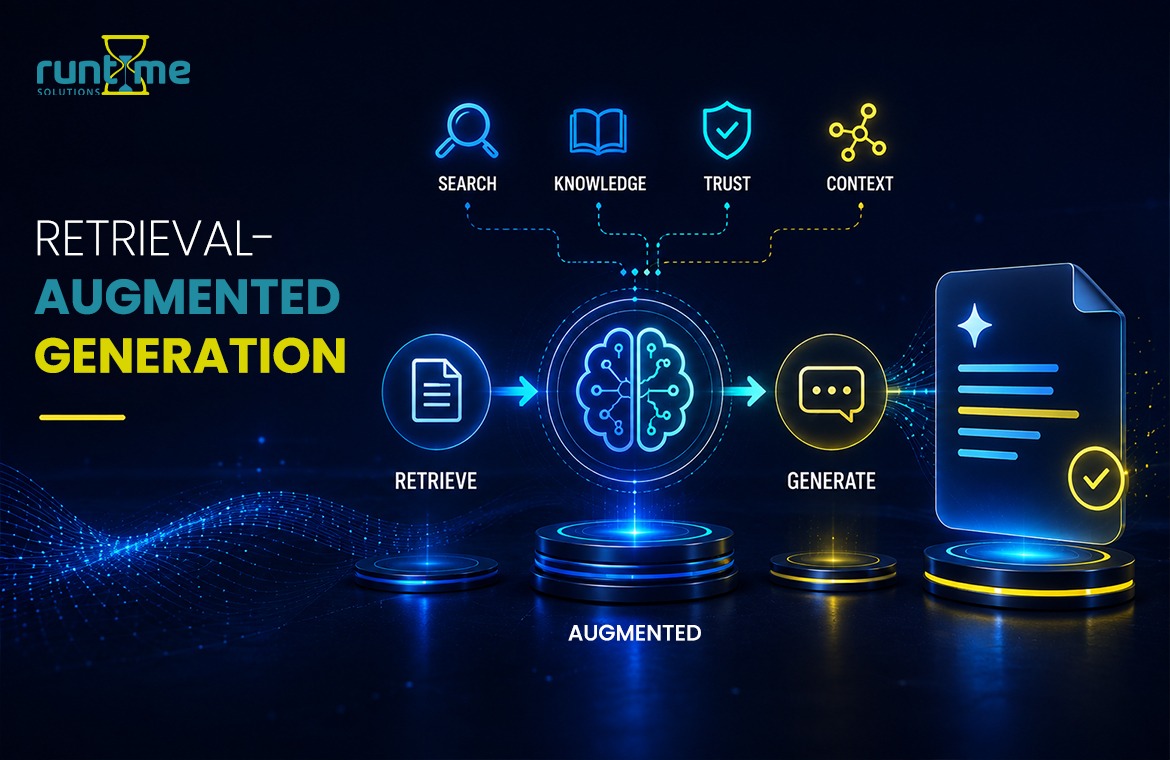
Retrieval-Augmented Generation (RAG) is a technique that makes an AI language model more accurate by having it look up relevant information from an external source — your documents, your website, your database — and use that information to generate its answer, instead of relying only on what it memorised during training. In simple terms, RAG lets an AI “check its notes” before it answers, rather than answering from memory alone.
That single change is what separates an AI that confidently invents facts about your business from one that answers correctly using your real information. It’s the technology behind trustworthy customer-support chatbots, internal knowledge assistants, and any AI that needs to be right about specific things rather than merely fluent. This guide explains what RAG is, why it matters, how it compares to the main alternative, and where its limits are — without assuming a technical background.
The Problem RAG Solves
To understand why RAG exists, you have to understand what’s wrong with a language model on its own.
A large language model (the technology behind tools like ChatGPT) is trained on an enormous amount of general text. That makes it remarkably good at understanding and producing language — but it has three serious weaknesses when you need it to be accurate about real-world specifics.
First, it hallucinates. When a model doesn’t know something, it doesn’t stay silent; it generates a plausible-sounding answer anyway, presented with complete confidence. For a business, that means an AI cheerfully inventing a refund policy, a price, or a product detail that was never true.
Second, its knowledge is frozen and general. The model only knows what was in its training data, up to a cut-off date. It knows nothing about your business specifically, nothing about anything that changed after training, and nothing about your private or proprietary information.
Third, it can’t show its sources. Because the model answers from a blur of everything it absorbed, it can’t point to where an answer came from, so there’s no way to verify it.
RAG addresses all three at once. By retrieving real, current, specific information and handing it to the model at the moment of the question, RAG grounds the answer in fact, keeps it up to date, and — done well — lets the AI cite exactly where the answer came from.
How RAG Works, at a High Level
The name describes the process. RAG combines retrieval (looking things up) with generation (writing an answer), so that generation is augmented by what was retrieved.
Conceptually, three things happen when someone asks a question:
- Retrieve. The system searches an external knowledge source — your ingested documents, web pages, or database — for the passages most relevant to the question. Crucially, this search works by meaning, not just keywords, so it finds the right content even when the question is phrased differently from how the source is written.
- Augment. The retrieved passages are added to the question and passed to the language model as context — effectively saying, “Here is the relevant information; answer using this.”
- Generate. The model writes a natural-language answer grounded in those passages, rather than from its general training. The best implementations also cite the source, so the answer can be verified.
That’s the whole idea: look up the right information, then answer from it. The technical machinery underneath — how content is broken into chunks, converted into searchable numerical representations called embeddings, and stored for fast semantic search — is where the engineering lives. If you want that pipeline explained step by step, it’s worth reading a dedicated breakdown of how a website-aware chatbot reads your content, which walks through the ingestion and retrieval mechanics in detail. For understanding RAG as a concept, the three-step summary above is what matters.
RAG in Action: A Simple Example
Imagine a customer visits an online store and asks a chatbot, “Can I return a sale item?”
Without RAG, the chatbot answers from general training. It knows what return policies tend to look like, so it might confidently say “Yes, within 30 days” — which may be completely wrong for this particular store.
With RAG, the moment the question arrives, the system searches the store’s own content and retrieves the actual passage from its returns policy — say, “Final-sale items are not eligible for return or exchange.” That passage is handed to the model, which then answers: “Items marked as final sale can’t be returned or exchanged, though standard-price items can be returned within 30 days.” The answer is now correct, specific to this business, and — if the system is built for it — can link to the exact policy page it came from.
Same question, same model. The only difference is that RAG gave it the right information to answer from — and that difference is everything.
RAG vs Fine-Tuning: The Comparison That Matters
If you’re evaluating how to make an AI accurate for your business, RAG isn’t the only option you’ll hear about. The other is fine-tuning, and understanding the difference is the single most useful thing in this guide, because people frequently reach for the wrong one.
Fine-tuning means taking a language model and training it further on your own data, adjusting the model’s internal parameters so your information and desired behaviour become baked into the model itself. RAG leaves the model untouched and instead supplies relevant information from an external source at the moment of each question.
The practical differences follow from that:
- Updating knowledge. With RAG, updating what the AI knows is as simple as updating your documents and re-indexing them — no retraining. With fine-tuning, new or changed information means retraining the model, which is slow and costly. For anything that changes regularly — prices, policies, inventory, documentation — RAG is far more practical.
- Accuracy and sources. RAG grounds answers in retrievable passages and can cite them, which makes answers verifiable. Fine-tuning blends your data into the model’s weights, so it still can’t reliably point to a source and can still hallucinate.
- What each is good at. RAG is best for injecting knowledge — facts, documents, current and proprietary information. Fine-tuning is best for teaching behaviour — a specific tone, format, style, or a specialised task the base model handles poorly. Fine-tuning changes how the model acts; RAG changes what it knows.
- Cost and data control. RAG is generally cheaper to maintain and keeps your data in your own store, where you control it. Fine-tuning requires a training process and embeds your data into the model.
The important nuance: these are not rivals so much as tools for different jobs, and sophisticated systems often use both — fine-tuning to shape how the AI behaves and communicates, RAG to keep it factually grounded and current. But if your goal is an AI that answers accurately about your specific, changing information — which is what most businesses actually need — RAG is almost always the right foundation.
The Benefits of RAG
Pulling the advantages together, RAG delivers value in ways that matter directly to a business deploying AI:
Dramatically reduced hallucination. By anchoring answers to real retrieved content, RAG sharply cuts the rate at which the AI invents things. Studies of retrieval-grounded systems consistently show more accurate, more trustworthy answers than ungrounded models.
Always-current information. Because knowledge lives in an external source you control, keeping the AI up to date means updating your documents — not retraining a model. Change a policy, and the AI reflects it as soon as the content is re-indexed.
Answers grounded in your specific business. RAG lets the AI answer from your actual products, policies, and processes, rather than generic knowledge that doesn’t reflect how you operate.
Verifiable, cited answers. A well-built RAG system can show the source passage behind an answer, so customers can verify it and your team can audit it. That traceability builds trust in a way a black-box answer never can.
Cost efficiency. Updating a knowledge base is far cheaper than repeatedly retraining a model, making RAG the economical path to keeping an AI accurate over time.
Data control and privacy. Your information stays in your own knowledge store rather than being baked into a model, which matters for proprietary and regulated data — an increasingly important consideration under data-protection rules like India’s DPDP Act.
Where RAG Is Used
RAG has quietly become the standard foundation for AI that needs to be reliable about specific information. Common applications include:
- Customer-support chatbots that answer from a company’s own help documentation, policies, and product information — the most visible everyday use of RAG.
- Website chatbots that respond to visitor questions using the business’s actual site content rather than generic answers.
- Internal knowledge assistants that let employees ask questions across company wikis, handbooks, and policy documents instead of hunting through folders.
- Documentation and technical-support assistants that ground answers in product manuals and knowledge bases.
- Enterprise search that returns synthesised, sourced answers rather than a list of links.
In each case, the common thread is the same: the organisation has specific, often changing information that the AI must be accurate about, and RAG is what makes that possible.
The Limitations and Challenges of RAG
RAG is powerful, but it is not magic, and being honest about its limits is what separates a realistic deployment from a disappointing one.
It’s only as good as your content. RAG can only retrieve and answer from what you give it. If the answer to a question doesn’t exist in your source material, or your content is thin, outdated, or contradictory, the AI’s answers will reflect that. Garbage in, garbage out applies fully.
Retrieval quality sets the ceiling. If the system retrieves the wrong passage — because of poor chunking, weak search, or ambiguous content — the model will generate its answer from the wrong information. Much of the engineering effort in a good RAG system goes into making retrieval accurate.
It reduces hallucination but doesn’t eliminate it. If retrieval fails or the source is ambiguous, the model can still produce a confident, wrong answer. Guardrails — including the AI’s willingness to say “I don’t have that information” — remain essential.
It needs to stay fresh. An external knowledge source only helps if it’s kept current. Content that’s ingested once and never refreshed will produce outdated answers, so re-indexing when your material changes is part of running RAG well.
It adds some complexity and latency. The retrieval step takes time and requires infrastructure — a searchable index, an embedding process, and the logic to tie it together. For most business uses this is well worth it, but it’s real work, not a switch you flip.
Where RAG Is Heading: Agentic RAG
RAG continues to evolve, and the most significant recent development is agentic RAG. In a basic RAG system, the retrieval step happens once and the model answers from whatever comes back. In an agentic approach, the AI evaluates whether its first retrieval was actually useful and, if not, refines its search and tries again — a self-correcting loop that improves accuracy on harder, multi-part questions.
The practical effect is a system that’s more robust when a question is complex or when the first search misses. For businesses, it means RAG-based AI is steadily getting better at handling the messy, real-world questions that used to trip it up — while keeping the core advantage of being grounded in real, verifiable content.
RAG and Your Business’s AI
For most organisations, the point of understanding RAG isn’t the technology itself — it’s what it makes possible. If you want an AI chatbot on your website that answers customers accurately about your products, policies, and prices rather than inventing them, RAG is the mechanism that makes that trustworthy. It’s the difference between an AI that sounds impressive in a demo and one you can actually put in front of customers without worrying what it will say.
This is exactly why a well-built website chatbot is trained on your own content. A chatbot like Runtime Solutions’ AI chatbot uses this retrieval-grounded approach so it answers from your real website pages and documents, stays current as you update them, and hands off to a human when a question falls outside what it can ground — the practical payoff of RAG, delivered without you having to build the pipeline yourself. When you’re evaluating any AI chatbot, the most important question to ask is simply whether, and how well, it grounds its answers in your content — because that grounding is what RAG is, and it’s what determines whether the AI is genuinely useful or quietly risky.
Frequently Asked Questions
What is Retrieval-Augmented Generation in simple terms?
It’s a technique that lets an AI look up relevant information from an external source — like your documents or website — and use it to answer a question, instead of answering only from what it learned during training. It’s the difference between an AI answering from real, retrieved facts and answering from memory, which is what makes RAG far more accurate for specific, current information.
What is the difference between RAG and fine-tuning?
RAG supplies information to the model from an external source at the moment of each question, leaving the model itself unchanged. Fine-tuning trains the model further on your data so the information is baked into it. RAG is best for injecting knowledge that changes or needs to be cited; fine-tuning is best for teaching the model a specific behaviour, tone, or task. Many advanced systems use both.
Does RAG stop AI from hallucinating?
It greatly reduces hallucination by grounding answers in real retrieved content, but it doesn’t eliminate it entirely. If the system retrieves the wrong information, or the source content is missing or ambiguous, the AI can still produce a confident, incorrect answer. Retrieval quality and guardrails are what keep a RAG system reliable.
Is RAG the same as a vector database?
No, though they’re related. A vector database is one component often used within a RAG system — it stores content as searchable numerical representations (embeddings) so the system can find passages by meaning. RAG is the overall technique of retrieving relevant information and using it to generate an answer; the vector database is part of the retrieval machinery.
Why is RAG important for customer-facing AI?
Because customer-facing AI has to be accurate about your specific business — your prices, policies, and products — and it has to stay current as those change. RAG grounds the AI in your real, up-to-date content, dramatically reducing the risk of it inventing answers, which is exactly what you need before putting an AI in front of customers.
Do I need technical expertise to use RAG?
To build a RAG system from scratch, yes — it requires engineering. But to use RAG, no. Most businesses access it through a chatbot or AI platform that handles the retrieval pipeline for them; you simply provide your content, and the platform does the grounding. What matters as a buyer is confirming that the tool genuinely grounds its answers in your content, which is the core of RAG.