
The e-commerce ecosystem globally has long been dominated by monopoly practices and centralized control. Over many years, big e-marketplaces have evolved as the lords of the internet age; running closed systems where they unilaterally decide rules of engagement, decide transactional costs, manage key data streams, and even control communication exclusively via their own apps.
Such large-scale marketplaces have not only forced small players to pay exorbitant commission rates to stay alive but also tied customers down to goods available within one marketplace alone. However, such monopoly-dominated system is soon going to be disrupted altogether. Open Network for Digital Commerce (ONDC), introduced by DPIIT of the Government of India as a mission-driven non-profit, is revolutionizing the very economics of international trade.
Analogy of an Email
In order to fully appreciate the extent of disruption brought about by ONDC, it would help to understand the concept using a simple yet powerful digital analogy that most people interact with in their day-to-day lives: electronic mail.
[Gmail User] ───────( Universal Open Protocol: SMTP ) ───────► [Outlook User]
A user of a Gmail account does not encounter any problem sending emails to a person who has an account with Outlook, Apple Mail, and Yahoo. This is facilitated through an open protocol that exists universally. Users do not have to register in five different email platforms just to exchange emails with five other people.
This is, unfortunately, not the case with traditional digital commerce. For instance, when a consumer is registered to Platform A, he or she cannot view, communicate, or purchase services/products offered by a vendor who registers solely with Platform B. Enter ONDC. It is a decentralizing framework that allows the use of a new protocol in conducting digital commerce between completely independent customer apps, vendors, and logistics providers.
Three Components of the ONDC Network Architecture
What sets ONDC apart from other marketplace applications is its approach of unbundling the commerce value chain. In most marketplaces, a monolithic software manages the entire process, which makes it very difficult for smaller and niche players to get into the game.
ONDC completely changes the equation by separating each component of the above value chain and creating a separate entity using an open API approach for each.
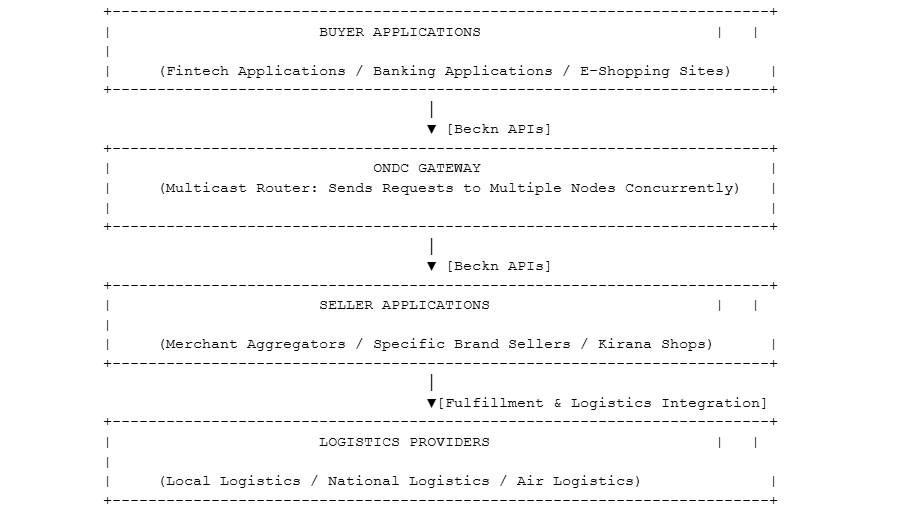
1. Buyer Applications (The Demand Aggregators)
Buyer applications function as the main shopping portal in the network ecosystem. In these applications, one may shop for everything from food and apparel to railway travel tickets, ready-made food products, or ride-sharing services.
Since ONDC is a fully decentralized protocol, any digital application can instantly become an e-commerce storefront by connecting to the network ecosystem. For example, large retail banks, telecommunication applications, or digital wallets can all have built-in full-fledged e-commerce capabilities.
When a user enters some search phrases in an ONDC-supported buyer application, the application queries the open ecosystem rather than a dedicated proprietary database. In other words, the application searches the entire network ecosystem for matching vendors and offers them at the same time to the consumer.
Engineering Challenges: The creation of a buyer application implies building advanced aggregation and user experience optimization engines. Since the product list that the application receives comes from a wide range of fragmented vendor ecosystems, an effective filtering system is needed to be implemented in the buyer application. This way, when a consumer searches for an electronic product, a duplicate record will be eliminated, taxes will be shown instantly, and shipping options will be evaluated dynamically.
The frontend needs to be sleek and agile in order to mask the intense backend API polling happening under the surface for all transactions across the registry network, sustaining that instant transaction speed that users have come to expect from their legacy counterparts.
2. Seller Applications (The Supply Orchestrators)
At the other end of the transaction chain are the seller applications. The design of these apps is specifically geared towards helping physical brick-and-mortar retail establishments, farmer cooperatives, independent artisan brands, and smaller family-run grocers (kiranas) digitize their inventories and push their offerings out to the rest of the network.
The real transformative impact of this system comes through in its comprehensive visibility – the moment any physical business uploads their product catalog on even just ONE seller application compliant with ONDC, those products immediately become visible and shoppable by every SINGLE buyer app user on the network. Rather than spending millions of dollars listing products across 3-4 separate company marketplace sites, integrating with the network is sufficient to access all digital buyers in the nation.
Local Catalog Upload ──► One Seller App ──► Visible to ALL Buyer App on Network
From a structural perspective, the seller application should serve as an intelligent intermediary between traditional retail operations and open protocols. This necessitates the creation of specific adapters to interface with already existing ERP systems, localized POS systems, and custom databases.
There needs to be instant inventory updates within the distributed ledger. For example, when the last bottle of olive oil available within a local grocery shop is bought by a physically present customer, the seller application needs to automatically update the inventory within the ONDC network to ensure that digital buyers do not place unfulfilled orders for the olive oil.
3. Logistics and Gateway Providers (The Operational Fabric)
Lastly, the fulfillment loop is an absolute necessity within the network architecture. Under the ONDC model, the logistics of delivering the goods is separated from the consumer platform as well as the retailer. Once a transaction takes place between buyer and seller applications, the network triggers independent logistics providers to fulfill the loop.
All kinds of hyperlocal couriers, trucking services, and even national air freight services will be able to post their logistics services as autonomous logistics nodes on the platform. After the order fulfillment process begins, the carrier applications on the platform offer dynamic quotes based on factors like pickup/drop-off locations, payload, and the desired delivery speeds. In turn, the merchant or customer gets to choose the most efficient way of delivery right at that moment without any obligatory courier tie-ins enforced by the platform.
Such a decoupling would set off an entirely new era of competition based on geography and speed. Small regional courier service providers who couldn’t afford to compete for enterprise contracts because of million-dollar marketing budgets could finally be considered on a level playing field. This time, since the matching algorithms of ONDC depend only on geographic and logistical considerations rather than market share, a hyperlocal courier riding his motorcycle might actually win over the huge logistics corporation to deliver to the city.
Technical Basis: Beckn Protocol & Asynchronous Discovery
Constructing a highly scalable commerce engine that covers thousands of independently existing software applications without the aid of an expensive and centralized database demands a universal open language. ONDC depends significantly on the Beckn protocol—decentralized and open API standards that enable totally unrelated software programs to discover each other and execute transactions. Beckn offers a highly powerful framework for geolocation, itemization, and real-time transactions.
[Buyer App] ──(Search)──► [ONDC Gateway] ──(Broadcast)──► [All Seller Apps]
[Buyer App] ◄──(Compile Results)── [ONDC Gateway] ◄──(Quotes)─────┘
The discovery protocol in this open network is asynchronous:
1 Trigger Search
Standardized Request
A user enters an item search request into a participating buyer application.
2 Broadcast Search
Multicast Transmission
The buyer application sends the request to the ONDC Gateway, a sophisticated routing program that broadcasts the request to all regional seller applications.
3 Response from Seller Applications
Local Stock Check
Seller applications quickly search their local databases, calculate real-time stock levels, and send standardized answers to the gateway.
4 Result Compilation
Unified Display
The buyer application compiles these fragmented packets of information into one unified view for the customer.
By utilizing this decentralized approach, the network guarantees absolute neutrality. In a traditional e-commerce ecosystem, corporate marketplace owners utilize opaque, black-box search algorithms that frequently prioritize their internal private-label products or push vendors who purchase expensive sponsored ads to the top. On an open protocol like ONDC, discovery is democratic. Search results are filtered and arranged based on transparent, consumer-centric criteria such as price competitiveness, actual geographic proximity, true fulfillment speeds, and historical merchant reliability scores.
Moreover, this particular framework for discovery depends greatly on accurate taxonomy synchronization. In light of thousands of different merchants generating data inputs at once, the network interfaces are bound to maintain a stringent hierarchy within the classification process. As soon as there is a request to find “organic cotton sheets,” the Beckn-enabled discovery protocol makes sure that the text parameters are synchronized throughout all the databases involved, irrespective of the merchant labeling the product as being related to home furnishings, bedroom accessories, or organic bedding material. This will ensure that the search does not get fragmented, and every rural merchant gets its due share of recognition.
Economic Impact: Democratization of the Digital Value Chain
The overall economic objective behind ONDC is to promote ultra-inclusive digital development. Despite rapid developments in global e-commerce activities, the spread of digital transactions has been very lopsided as these transactions take place mostly between tech-savvy people and large corporations. The reason why large corporations and technologically savvy people are able to benefit from such transactions is because these people have the financial muscle necessary to operate on the digital platform. Small-scale businesspeople are often marginalized in the process of doing e-commerce transactions due to the high platform commission rates which can range from 20% to 40%.In addition, the process of isolation of data that has been observed through the concept of platform capitalism is significantly disrupted by the creation of open networks. While
| Feature / Metric | Traditional E-Commerce Monopolies | Open Network for Digital Commerce (ONDC) |
| Architecture of System | Centralized and closed proprietary databases system | Decentralized and open-source Beckn protocol system |
| Average Take-Rate | High take rates (usually ranging from 20% to 40%) | Extremely low take-rates(usually around 3% to 5%) |
| Data Ownership | Marketplace control all data owned by buyer and seller | Parties control their data fully |
| Algorithmic Discovery | Opaque algorithms prioritizing ad spend and private labels | Serious, location-based algorithmic discovery |
| Logistics Fulfillment Loop | Limited to approved platform carriers | Logistics bidding network is totally open |
under a closed market system, the platform owner will retain the full control of purchase history logs, behavioral patterns of consumers, and demographic information. However, the vendors of the products have no clue whatsoever about the information regarding the transactions. However, in ONDC, the data is shifted in favor of the merchants, who would know exactly how to manage the stock and even build their brands without the walls of third-party applications.
Such changes will also create a significant effect on the larger financial services market. Traditionally, it was difficult for smaller mom-and-pop merchants to get traditional banking services since they did not have any transaction log data that was available to banks in the first place. Now, with the help of cryptography and blockchain technologies, the merchants will be able to produce transaction statements, which would serve as their verification tools. These developments pave the way for formal micro-financing, working capital finance, and access to low interest credits which were inaccessible in the past for unbanked or underbanked businesspeople.
Engineering for the Network: Issues and Methods of Resolution
Moving from designing a privately-owned software program to developing an application using network-wide protocols poses serious engineering difficulties and issues. In particular, for business programmers and digital architects, creating an ONDC-compliant application means totally reinventing how to process and secure data and how to make transactions consistent and reliable. Transaction consistency in a centralized system is relatively easy since all changes take place in a single database through atomic processing. Consistency within an open network implies perfectly synchronized actions of independent systems across the internet.
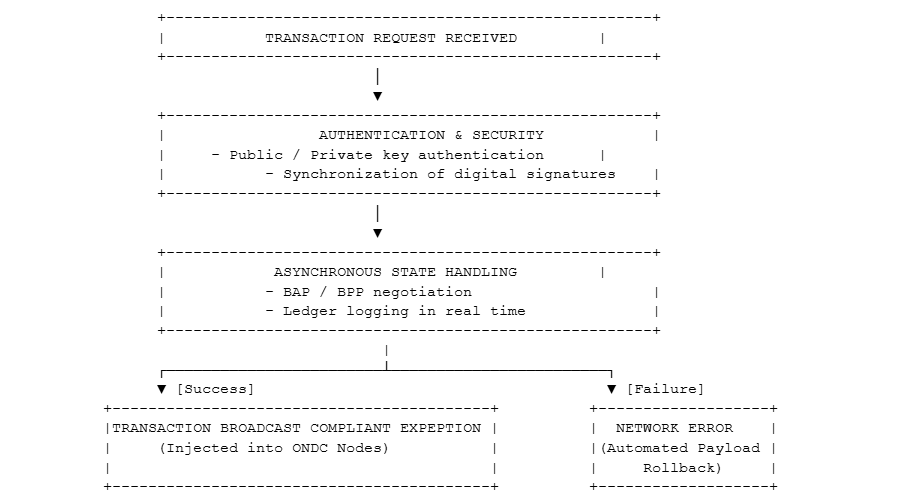
Security on the open network requires extensive cryptographic capabilities to function properly. As the transactional messages travel between multiple network nodes, every participant is required to cryptographically sign his transactional payload by using unique public/private key pairs. The security functions are managed by the network registry, which continuously verifies the cryptographic signature of all buyer applications, seller applications, and gateway nodes engaged in each transaction flow to make sure that malicious users do not spoof orders, modify product prices in transit, or hack sensitive customer data.
Conclusion: Representing the Digital Future
The Open Network for Digital Commerce can be considered much more than just a regional policy innovation; rather, it should be viewed as a structure for future development of global digital commerce itself. By disrupting vertical business models of legacy market aggregators, ONDC transforms online commerce into an entirely new network environment based on transparency, efficiency, and value pricing rather than huge marketing budgets. In such a fast-growing multi-billion ecosystem, the early establishment of an online presence is no longer an option but a necessity for innovative companies.
The shift from traditional and compartmentalized storefronts to open network architectures poses significant structural challenges that need specific skills and competencies. This is precisely the area where the end-to-end solution offered by Runtime Solutions is enabling brands to successfully navigate the digital divide. Founded in 2010 and based in Mumbai with an expanding global presence including branches in Kolkata, Nagpur, and Dubai, Runtime Solutions has been disrupting digital conventions for close to 16 years now. As a technology company and digital transformation partner par excellence, they offer unique solutions for closing infrastructure gaps for organizations looking to grow.
Rather than leaving companies to struggle with the complexities associated with the decentralized discovery process and multiple-node transaction routing, Runtime Solutions provides an all-encompassing, white label architectural solution designed for open network compatibility. Ranging from ONDC gateway integration to secure payment split routing mechanisms and optimal vendor dashboard setup, the company’s solution eliminates all the hassles and heavy lifting required when it comes to the networking aspect. With the company’s extensive experience in product development, coupled with its team of innovation experts, businesses can be assured that they can easily deploy scalable backend commerce applications to be compatible with any global open standard registry. To find out how Runtime Solutions E-Commerce Platforms can help you revolutionize your business architecture to fully capitalize on digital democratized commerce, visit the Runtime Solutions Main Portal.